

How Do You Identify Burrowing Animal Holes
One of the more mutual enquiries we receive is "What animal made this pigsty in my garden?". Unfortunately, holes are some of the more difficult things to identify, as a photo usually doesn't contain that much information.
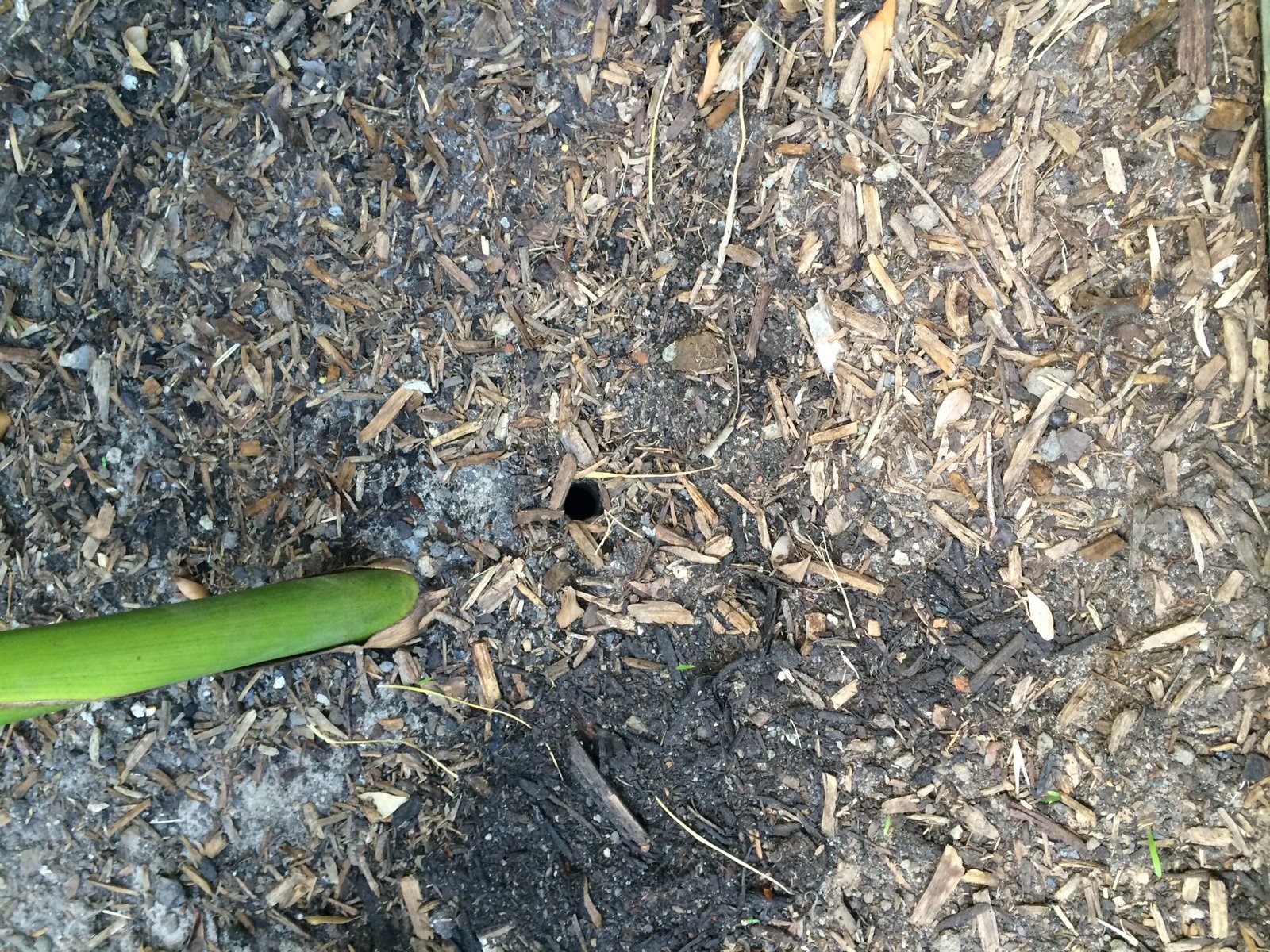
Photo submitted through our Inquire an practiced enquiry organization of a hole found in a garden. Image: Ask an expert
© Australian Museum
Animals sometimes create holes (a hollow spot in the ground) or burrows (shelter made in the ground often used for home). Animals can besides make holes while foraging for food, particularly in the instance of bandicoots.
We accept tried to include the nigh mutual holes/burrows that tin can be plant in the Greater Sydney surface area, so some animals further out of this area might not be included in this post.
When identifying holes, nosotros endeavour and see if there are any clues in the images and make an educated proposition based off what information we tin see or that the enquirer has provided.
Some of the questions we need to ask to narrow down the hole occupant include: where is the pigsty (is it next to a tree, under cover, out in the open), are there whatsoever special features (soil on the side, silk lines radiating out from the hole, a cap on the burrow) and how big is the hole. We would also demand to know where the construction was plant (in a garden, nearly a national park and where in Australia it was found). Holes that are found in a suburban surround tin be different to the ones we find in the bush. For instance, spider burrows out in the bush tin can take unusual looking trapdoors, palisades and tubes leading upwardly rocks. Smallish burrows that are institute in a swamp could indicate the burrow of a crayfish.
Soil limerick is some other tool that can be used to help us place what type of creature created the hole. A small-scale pigsty in sandy soil could hateful the home of a Sand Wasp. Holes found in clay soils could signal the presence of Blue Banded Bees.

Sand Wasp, genus Bembix Prototype: Jiri Lochman
© Jiri Lochman/Lochman Transparencies
Of class, this is not a fool-proof method. Oftentimes it is all-time if we run across an image of the brute inside the hole so we can confirm if the hole is indeed from that item animal.
In summer, small holes next to trees are first-class indicators of cicadas and help us understand the cicada life wheel. Female person cicadas use their ovipositor (a tube-like structure at the end of the body of female cicadas and other insects used to lay eggs) to brand slits on branches, where she will eventually lay her eggs. The nymphs then hatch and drop down, burrowing into the soil to feed upon the sap from tree roots. Just before it emerges from the ground, the cicada will create a turret of soil that stops h2o and mud from inbound the hole. Then, afterward a bit of rain, the juvenile cicadas emerge from the soil, leaving backside a clean hole. Seeing the shedding (as well called the exuvia) on a nearby tree or post volition add a little more testify to the ascertainment.

Holes made by Double Drummer cicadas, Thopha saccata, in Wedderburn, NSW. Matchbox included for calibration. Image: Dave Britton
© Dave Britton
Burrows that have silk lines radiating outwards and are under cover, or in a shady office of the garden, tell u.s.a. that it could be the home of a Funnel Web Spider. The silken strands around the burrow work as trip lines, used to alert the spider hiding inside the burrow that something is outside.
Trapdoor Spider burrows are often dislocated with those of a Funnel Web. However, Trapdoor Spider burrows can have a 'lid' or be completely open with a 'collar' of silk around the entrance. The burrows of the Trapdoor Spider are more likely to be out in the open when compared to the secluded and covered burrows of Funnel Webs.
Small-scale holes, effectually 2-3cm in diameter, could indicate Wolf Spiders. Their burrows tin have completely open holes with no silk, and some utilise a trapdoor to close the burrow. In wetter atmospheric condition, Wolf Spiders in arid areas construct turrets to terminate water from entering.
The hole in your garden could besides be from an earthworm. Earthworms aerate the soil, which means they spread the soil out and decompress it, allowing air (oxygen) to travel below the soil. This normally goes unnoticed as information technology happens underground. However, if the soil is compressed and saturated with h2o, the oxygen that earthworms need to breathe cannot pass through the soil to the areas deeper downwards where they burrow. To help oxygen to flow deeper, the worms make holes at the surface. If the surrounding expanse is compressed, the soil that passes through the gut of the earthworm and out the other cease has nowhere else to get only out the hole the worm has made, resulting in dark mounds. These are called 'worm casts'.
Larval beetles can also sally from the soil, leaving behind a hole. Many avid gardeners would have noticed small, white grubs in the garden while excavation through the soil. These white larvae (as well known equally curl grubs), if allowed to complete their lifecycle, go from a pupa (the side by side life stage that is in between the chow and developed course) and turn into an developed beetle.
Bees, wasps, crickets and larval butterflies and moths (caterpillars) take also been known to create holes in the garden. Ants create more complex burrows clandestine but, on the surface, a simple opening usually surrounded past sand or dirt is visible.
Larger holes can indicate the presence of rats, particularly if the hole is located well-nigh a craven coop or compost heap. Rats build burrows from their nest to their food source but can as well utilise them as an escape route.

Photograph submitted through our Ask an proficient enquiry system of a rat hole into a craven coop. Taken about Lindfield, NSW 2070. Epitome: Diana Evans
© Australian Museum
If you doubtable rats are the culprits, y'all can bank check for greasy marks left on the sides of buildings. Rat holes/burrows look different when comparing them to the conical bandicoot feeding hole. Bandicoots feeding holes are around 10cm deep and have a mound of dirt lying beside the hole. Commonly looking for curl grubs (larvae of scarab beetles), the bandicoot aerates the soil and assists with organic mixing of the soil.
In Sydney, the most common bandicoot species is the Long-nosed bandicoot (Perameles nasuta). Scat (poop) and footprints tin can help place burrows of larger mammals. If yous meet some scat or footprints in the soil, that could requite y'all some more clues every bit to who is living inside the couch.
Reptiles dig by pushing soil outwards instead of between their legs. Their burrows (usually but non always) take a more triangular shaped opening. Erosion tin change the shape of the opening which makes identification tricky. If hook marks or scats can be seen around the opening, information technology would make identification easier.
To make things a little more than difficult, animals have been known to exist opportunistic and apply the burrows other animals have fabricated.
In the terminate, holes are particularly tricky to place and there are always exceptions to the 'rules', depending on the species. The best way to identify what is occupying a burrow is to see what fauna is inside. If the structure doesn't seem quite deep enough, information technology is probably a feeding hole, in which instance, see if there are any scats or footprints nearby.
Try looking at the burrow at various times during the twenty-four hour period, early morning and at dark to run into if you can spot whatever animal residing, entering or exiting the couch!
Source: https://australian.museum/learn/species-identification/ask-an-expert/what-made-this-hole/#:~:text=The%20best%20way%20to%20identify,any%20scats%20or%20footprints%20nearby.
Posted by: campbellthrecties61.blogspot.com
0 Response to "How Do You Identify Burrowing Animal Holes"
Post a Comment