

How Many Animals Are Carved Into The Tree Of Life

Miniature, Jacques de Besançon, Paris, c.1485. Showing 43 generations. Beneath, the birth and babyhood of Mary


The Tree of Jesse is a depiction in fine art of the ancestors of Jesus Christ, shown in a branching tree which rises from Jesse of Bethlehem, the father of King David. It is the original utilize of the family tree as a schematic representation of a genealogy.
The Tree of Jesse originates in a passage in the biblical Book of Isaiah which describes metaphorically the descent of the Messiah and is accustomed past Christians as referring to Jesus. The various figures depicted in the lineage of Jesus are drawn from those names listed in the Gospel of Matthew and the Gospel of Luke.
The subject is frequently seen in Christian art, especially in that of the medieval catamenia. The earliest example is an illuminated manuscript which dates from the 11th century. In that location are many examples in medieval psalters, because of the relation to King David, son of Jesse, and author of the Psalms. Other examples include stained glass windows, stone carvings around the portals of medieval cathedrals, and painting on walls and ceilings. The Tree of Jesse too appears in smaller art forms such as embroideries and ivories.
Origins [edit]
Depictions of the Jesse Tree are based on a passage from the Volume of Isaiah.
"And there shall come forth a rod out of the stem of Jesse, and a Co-operative shall grow out of his roots" (Rex James Version).
From the Latin Vulgate Bible used in the Heart Ages:
et egredietur virga de radice Iesse et flos de radice eius ascendet (Isaiah 11:1).
Flos, pl flores is Latin for bloom. Virga is a "greenish twig", "rod" or "broom", likewise every bit a user-friendly almost-pun with Virgo or Virgin, which undoubtedly influenced the development of the image. Thus Jesus is the Virga Jesse or "stem of Jesse".
In the New Attestation the lineage of Jesus is traced by two of the Gospel writers, Matthew in descending order, and Luke in ascending order. Luke'due south Gospel's description in chapter 3 begins with Jesus himself and is traced all the style back, via Nathan to David and so on to "Adam, which was [the son] of God.". (Luke 3:23–38) Matthew'south Gospel opens with the words: "The volume of the generation of Jesus Christ, the son of David, the son of Abraham." (Matthew 1:one) With this beginning, Matthew shows the Abrahamic and purple descent, passing through David, but and then through Solomon.
Encounter Genealogy of Jesus for more than explanation of the differences, but both lineages let the interpretation that Jesus is the "stem of Jesse" past his descent from Jesse's son, David.
Employ [edit]
Pictorial representations of the Jesse Tree show a symbolic tree or vine with spreading branches to represent the genealogy in accordance with Isaiah'southward prophecy. The 12th-century monk Hervaeus expressed the medieval understanding of the prototype, based on the Vulgate text: "The patriarch Jesse belonged to the regal family, that is why the root of Jesse signifies the lineage of kings. Equally to the rod, it symbolises Mary every bit the flower symbolises Jesus Christ."[i] In the medieval period, when heredity was earth-shaking, much greater emphasis than today was placed on the actual purple descent of Jesus, especially past royalty and the nobility, including those who had joined the clergy. Between them, these groups were responsible for much of the patronage of the arts.
During the Medieval era the symbol of the tree equally an expression of lineage was adopted past the nobility and has passed into mutual usage initially in the form of the family tree and later as a fashion of expressing any line of descent. The grade is widely used as a table in such disciplines as biology. It is also used to show lines of responsibility in personnel structures such every bit government departments.[2]
Modes of delineation [edit]

A typical Jesse Tree of the Late Medieval period, detail of the Spinola Hours of Ludwig past the Master of James IV of Scotland, (1510-20)

The lower one-half of this page from the Vyšehrad Codex shows the earliest known depiction of a Tree of Jesse
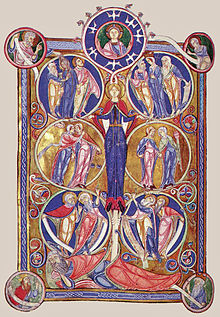
The Jesse Tree in the Lambeth Psalter, unknown English miniaturist, (1140s). Many characteristics of later on representations are fully adult.
The Jesse Tree has been depicted in most every medium of Christian art. In particular, it is the discipline of many stained glass windows and illuminated manuscripts. It is besides plant in wall paintings, architectural carvings, funerary monuments, floor tiles and embroidery. Generally but a few of the nigh well known individuals, like Kings David and Solomon, are represented on Jesse Trees, rather than an attempt to display the entire lineage.
The start representations of the passage in Isaiah, from near 1000 Advert in the Westward, prove a "shoot" in the grade of a direct stem or a flowering branch held in the mitt nearly often by the Virgin, or past Jesus when held past Mary, by the prophet Isaiah or by an ancestor figure. The shoot every bit an attribute acted every bit a reminder of the prophecy, come across likewise the tradition, plainly older, of the Gold Rose given past the Pope.[three] In the Byzantine world, the Tree figures merely every bit a normal-looking tree in the background of some Birth scenes, also a reminder to the viewer.[4] Indeed, the Tree was always far more common in Northern Europe, where it may accept originated, than Italian republic.
At that place exist likewise other forms of representation of the Genealogy of Jesus which do non employ the Jesse Tree, the near famous beingness that painted in the Sistine Chapel by Michelangelo.
The typical grade of the epitome
The near typical form which the Jesse Tree takes is to evidence the effigy of Jesse, frequently larger than all the rest, reclining or sleeping (perhaps by illustration to Adam when his rib was taken) at the pes of the pictorial space. From his side or his navel springs the body of a tree or vine which ascends, branching to either side. On the branches, normally surrounded past formally scrolling tendrils of foliage, are figures representing the ancestors of Christ. The torso more often than not ascends vertically to Mary and then Christ at the top.
The number of figures depicted varies greatly, depending on the amount of room available for the pattern. As a maximum, if the longer beginnings from Luke is used, there are 43 generations betwixt Jesse and Jesus. The identity of the figures also varies, and may not be specified, simply Solomon and David are usually included, and often all shown wear crowns. Nearly Jesse Copse include Mary immediately beneath the figure of Jesus (or, in the Gothic period, show a Virgin and Child), emphasising that she was the ways by which the shoot of Jesse was built-in. See for example, Sermon 24 of St Leo the Great: "In which rod, no doubt the blessed Virgin Mary is predicted, who sprung from the stock of Jesse and David and fecundated past the Holy Ghost, brought forth a new flower of human mankind, becoming a virgin-mother".[5] Saint Joseph is rarely shown, although dissimilar Mary he is a link in the Gospel genealogies. It was believed in the Center Ages that the Firm of David could only marry inside itself, and that she was independently descended from Jesse. Sometimes Jesus and other figures are shown in the cups of flowers, as the fruit or blossom of the Tree.[ane]
The Jesse Tree was the only prophecy in the Erstwhile Testament to exist then literally and frequently illustrated, then came also to stand for the Prophets, and their foretelling of Christ, in general. Both the St-Denis and Chartres windows include columns of prophets, every bit practise many depictions. Often they bear banderoles with a quotation from their writings, and they may signal to Christ, every bit the foretold Messiah.[ane] The inclusion of kings and prophets was too an assertion of the inclusion and relevance in the biblical canon of books that some groups had rejected in the past.[6]
While particularly popular in the Medieval era, at that place were also many depictions of the Jesse Tree in Gothic Revival fine art of the 19th century. The 20th century has also produced a number of fine examples.
Illuminated manuscripts [edit]
The Vysehrad Codex and Lambeth Palace Bible [edit]
The earliest known representation of the Jesse Tree can exist firmly dated to 1086 and is in the Vyšehrad Codex, the Coronation Gospels of Vratislav Two, the first monarch of Bohemia, which was previously a dukedom.[7]
In a paper analysing this image, J.A. Hayes Williams points out that the iconography employed is very unlike from that usually found in such images, which she argues relates to an assertion of the rightful kingship of the royal patron. The folio showing the Jesse Tree is accompanied past a number of other illuminated pages of which 4 depict the Ancestors of Christ. The Jesse Tree has not been used to support a number of figures, as is usual. Instead, the passage from Isaiah has been depicted in a very literal way. In the picture, the prophet Isaiah approaches Jesse from beneath whose feet is springing a tree, and wraps effectually him a banner with words upon information technology which interpret literally as:- "A niggling rod from Jesse gives rise to a excellent flower", following the linguistic communication of the Vulgate. Instead of the ancestors seen in subsequently depictions, seven doves (with haloes) perch in the branches. These, in a motif from Byzantine art, represent the Vii gifts of the Holy Spirit as described by the Apostle Paul.[7] [eight] Williams goes on to compare it with ii other famous images, the Tree of Jesse window at Chartres Cathedral and the Lambeth Bible in England.[seven]
Williams says:-
"While depictions of the Jesse Tree originated in Bohemia, the concept became widely popular throughout Europe and the British Isles. Within sixty years the composition had exploded and expanded, with rearranged original elements and new ones added."[7]
Withal this claim of Bohemian origin may be somewhat overstated, as there is an incipient version in an Anglo-Norman manuscript of similar date to the Vysehrad Codex.[9]
In the showtime decades of the 12th century, the early Cistercian illuminators of Cîteaux Abbey played an important function in the evolution of the image of the Tree of Jesse, which was used to counter renewed tendencies to deny the humanity of Mary, which culminated in Catharism. However, as Bernard of Clairvaux, strongly hostile to imagery, increased in influence in the society, their use of imagery ceased.[10] The Lambeth Bible is dated betwixt 1140 and 1150. The Jesse Tree illustration comes at the commencement of Isaiah and differs greatly from the earlier i, having much more the grade that is familiar from both manuscript and stained glass versions. In it, Jesse lies at the edge of the folio with the tree springing from his side. The branches of the tree are depicted as highly formalised round tendrils which enclose six pairs or trios of figures. At the center, tall and highly stylised in the same manner every bit 12th-century columnar statues, stands a full-length Blessed Virgin Mary from whose head spring tendrils which enclose a bust of her Son, Jesus. He is encircled past the seven doves, with outspread wings; this became the usual delineation of them. Four Prophets with scrolls occupy medallions in the corners.


Other illuminated manuscripts [edit]
The Tree appears in several other Romanesque Bibles autonomously from the Lambeth Bible, unremarkably as a large historiated initial at the outset of either Isaiah or Matthew. The Saint-Bénigne Bible is possibly the primeval appearance, with just Jesse and the doves of the "Seven Gifts". The Capuchin's Bible (see picture) is a later case, c. 1180, in which a Jesse Tree forms the 50 of Liber generationis.. at the get-go of the Gospel of Matthew.[11]
The Tree is likewise often found in Psalters, especially English manuscripts, illustrating the B initial of Beatus Vir, the start of Psalm 1, which often occupies a whole folio. Sometimes this is the only fully illuminated page, and if it is historiated (i.due east. contains a pictured scene) the Tree is the usual field of study. When not historiated, the initial had for about 2 hundred years been most often fabricated up of, or filled with, spiraling plant tendrils, frequently with animals or men caught up in them, so the development to the tree was a relatively easy stride. Indeed, although Jesse's son David was believed to be the writer of the Psalms, it has been suggested that the tradition of using a Jesse Tree here arose largely because it was an imposing design that worked well filling a big B shape.
An early on instance is the late 12th-century Huntingfield Psalter, and an especially splendid one from the early 14th century is the Gorleston Psalter in the British Library.[12] In these and most other examples Jesse lies at the bottom of the B, and the Virgin is no larger than other figures. In the recently re-discovered Macclesfield Psalter of about 1320 another very elaborate Tree[13] grows beyond the B, sending branches round the sides and bottom of the text. In the Psalter and Hours of John, Duke of Bedford (British Library Add MS 42131), of about 1420–23, the Tree frames the lesser and both sides of the page, while the initial B at the meridian of the page contains the anointing of King David.
Some continental manuscripts give the scene a whole folio with no initial. "Various selections" of the elements appear, and prophets and sometimes even the Cumaean Sybil (Ingeburg Psalter c. 1210) stand in the corners or to the side. A Lectionary of before 1164 from Cologne unusually shows Jesse dead in a tomb or coffin, from which the tree grows.[iv] Romanesque depictions usually bear witness Jesse asleep on open ground or on a simple burrow - all that can exist told from the Bible near his circumstances is that he had sheep, which David herded. By the Gothic period small Copse are found in many types of manuscript, and Jesse is often more comfortably accommodated in a big bed.

Stained drinking glass [edit]
Stained glass was a popular medium used in many eras to illuminate the sacred mysteries of the Old Covenant's human relationship with the genealogy of Christ in the New Covenant.

The upper section of the Jesse Tree window at Chartres Cathedral showing Jesus at the noon and Mary beneath him
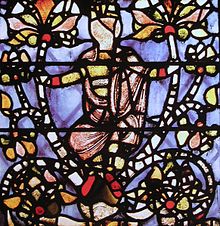
The fragment of a Jesse Tree window from York Minster, which is probably the oldest panel of stained glass in England (c. 1170)

Ii panels, all that remain, of a Jesse Tree window of the tardily twelfth or early 13th century, Canterbury Cathedral

Jesse Tree at Saint-Étienne church in Beauvais, France, by Engrand Le Prince, 1522–1524
Medieval [edit]
Jesse Tree at Chartres Cathedral [edit]
Amongst the famous stained drinking glass windows of Chartres Cathedral in Northern France is the Jesse Tree window, of 1140–fifty, the far right of three windows above the Royal Portal and beneath the western rose window. It derives from the oldest known (and almost certainly the original) complex form of the Jesse Tree, with the tree rising from a sleeping Jesse, a window placed in the Saint-Denis Basilica by Abbot Suger in almost 1140, which is now heavily restored.[4] [14]
The Chartres window comprises viii foursquare central panels, with 7 rectangular ones on either side, separated, every bit is usual in 12th-century windows with no stone tracery, by heavy iron armatures. In the everyman central console reclines the figure of Jesse, with the tree rising from his middle. In each of the seven sections it branches out into a regular pattern of scrolling branches, each bearing a bunch of leaves that take on the heraldic grade of the Fleur de Lys, very common in French stained glass. Central to each panel is a figure:- David, Solomon, two more crowned figures, Mary (mother of Jesus) and, surrounded by the doves begetting the gifts of the Spirit, a majestic figure of Christ, larger than the residuum. In each of the narrower panels, edged by richly patterned borders, are the figures of fourteen prophets bearing scrolls.
Apart from the theological importance the design is i of the few subjects that works very well equally a unified composition for 1 of the tall vertical spaces of the windows of Romanesque and Gothic churches; most other tall windows were divided into dissever scenes. Saint-Denis and Chartres provided a model for many other such windows, notably the Jesse Tree windows of Canterbury Cathedral, c. 1200, probably too fabricated in France, and St. Kunibert, Cologne of 1220–35. Section references:- Dark-brown,[15] Lee, Seddon and Stephens.[16]
York Minster, England [edit]
A small-scale and much fragmented panel from a Jesse Tree window, at York Minster is thought to be the oldest surviving stained drinking glass in England, dating from maybe as early as 1150.[15]
Canterbury Cathedral, England [edit]
This window, dating from c. 1200, had an unfortunate history. Having survived the Dissolution of the Monasteries, the depredations of the Puritans and the ravages of time, it was dismantled and removed, with many other original windows during the 19th and early 20th centuries, and replaced by a re-create. Fortunately ii surviving panels were afterward returned and are in identify in the Corona Chapel [17] at the eastern terminate of the edifice.
Wells Cathedral [edit]
Wells Cathedral has a rare instance of an intact 14th-century Jesse Tree window which survived the iconoclasm of the 17th-century and the losses of World War Two.[18] The window is located high up in the eastern end of the choir. The colours of this window are red, yellow, light-green, white and brown, with very trivial blue. The window is broad for its meridian, having 7 lights, and being topped by tracery. Consequently, the tendrils of the Tree spread out sideways and the central panel has but three figures: the reclining Jesse at the bottom; the Blessed Virgin holding the Christ Child in her arms and in a higher place, the crucified Christ. There are fourteen more figures in the window, identifiable in some cases past their attributes, such equally David'due south harp and Solomon's model of the Temple of Jerusalem. Equally well equally the tendrils, the figures are framed past typical 14th-century canopies and bases displaying the name of each person. The window is currently undergoing extensive conservation.[eighteen]
St Mary's Church, Shrewsbury [edit]
St Mary's Church in Shrewsbury, England contains an enormous 14th-century depiction of the Jesse Tree. By tradition, it was made for the Franciscan church in Shrewsbury, moved to St Chad's Church building later the Dissolution of the Monasteries, and then to St Mary's in 1792. Although information technology was much restored in 1858 by David and Charles Evans, much of the original glass remains and is dated between 1327 and 1353.
Other examples are at the Sainte-Chapelle in Paris (1247), the Cathedral of Le Mans (13th century) and Evreux Cathedral in Normandy (15th century).
Renaissance and classical [edit]
Dorchester Abbey, Dorchester, Oxfordshire
The north window in the sanctuary is unique as it combines tracery and sculpture with stained drinking glass in a single theme. It shows the ascent of Christ from Jesse. The tree with five undulating branches carved in leafage rises from the sculptured recumbent form of Jesse. Much of the 14th-century glass is fragmentary, just still in its original tracery. The figures of Christ and the Virgin and Kid with other figures are intact. The glass contains figures from a Tree of Jesse and additional figures are carved on stone mullions.
St. Leonard'south Church, Leverington, Cambridgeshire
A 15th-century restored Tree of Jesse window in the chapel of the east stop of the church building. Thirteen of the figures are original, seventeen are partly restored and thirty-one are mod. The kings are dressed in short doublets which are compared with similar figures in the manuscript of 1640 representing the victories of Edward IV which is in the British Library Harleian MS. 7353.
Holy Well and St. Dyfnog'due south Church building, Llanrhaeadr, Denbighshire, Wales.
The Tree of Jesse window was made in 1533. The window depicts Jesse asleep in a walled garden, from him springs a many branched family tree, in which can be seen the antecedent kings of christ. The figures resemble 'court' playing cards, which took their form at about the time the window was made.[xix]
Saint-Étienne church, Beauvais, France
A magnificent Renaissance three-lite window by Engrand Le Prince (1522–1524), with the majestic ancestors richly dressed in fashionable garments, rising from large flower-pods. Jesse has a splendid 4-poster bed. In the tracery, the fundamental section has the form of a Sacred Heart and contains the Virgin and Christ Kid rising from a lily and surrounded past radiant light.
Cathedral Notre-Dame, Moulins, Central French republic
Tree of Jesse window to a higher place Jesse can be seen a king on horseback from the 15th or 16th century.
19th and early 20th century [edit]


Particular of Jesse from the Stained Glass window of All Saints Church, Hove, Sussex. England
St. Bartholomew's Church building, Rogate, W Sussex.
The Jesse window of 1892 past Lavers & Westlake is a colourful design. All the figures are seated in the vine except for the Virgin Mary who is seated within a flowering virga, exterior the vine. Above her caput are seven doves representing the seven gifts of the Holy Spirit. The figures in the window are; in the starting time light – Hezekiah, Solomon, Melchizedek. Middle lite – Jesse, David, the Virgin and Christchild on her knee. Third light – Jehoshaphat, Asa, and Isaiah. The three light window is dedicated to the Honourable J J Carnagie born 8 July 1807 died eighteen January 1892, placed in the church by Henry Allen Rolls (blood brother of the co-founder of Rolls Royce Limited) in 1892.[twenty]
Pusey House Chapel, Oxford, Oxfordshire.
In the east window at that place is a Tree of Jesse commemorating Pusey, who was one of the leaders of the 19th-century Oxford Movement in the Church building of England. Pusey died in 1882 and Pusey House was established as his memorial. The window is by Sir Ninian Comper and contains figures of Old Testament prophets, and fathers of the Church, representing some of the areas of his written report, surrounding Christ in Majesty and the Virgin and Child. The effigy of Pusey can be seen, kneeling at the base of the 2d lite from the right.
St. Mary of the Supposition Church, Froyle, Hampshire
The Tree of Jesse five lite east window is by Kempe/Burlison & Grylls 1896. 19 figures can be seen including Jesse, King David, Male monarch Solomon, the Blessed Virgin Mary and Child.[21]
St. Matthew's Church, Newcastle, Northumberland.
Tree of Jesse window by Kempe 1899.[22]
St. Peter's Church, Stonegate, Wadhurst, E.Sussex
The 5 calorie-free west window is a Tree of Jesse window made by James Powell & Sons, London in 1910. Depicting 21 characters including Jesse, King David, Rex Solomon, The Virgin Mary and Kid.[23]
All Saints Church, Hove, E Sussex
The Tree of Jesse window at the west stop of the south aisle is by Clement Bong, installed past the firm Clayton & Bell in 1924. The window embodies a profusion of rich deep colours, reds, dejection, nighttime green, mauve and gilt. It has 4 upright sections, surmounted past quatrefoil insets depicting the Mother & Child, flanked by Joseph and Jacob. Below, shown in kingly attire is the genealogical lineage of Joseph with some of his forebears from the house of David, Salathiel, Zorobabel, Sadoc, Matthan, Ozias, Jehoshaphat, Ezekias, Josias, Roboam, King David, Solomon and Asa. Below these are the prophet Isaiah a recumbent Jesse, and in the lesser corner Matthew recording these details in the opening of his gospel.[24]
St. George'southward Church, Slough, Britwell, Berkshire.
A five light Tree of Jesse window is mentioned in the church inventory. A huge and spectacular window in 1-inch-thick (25 mm) glass, set in concrete, and made by James Powell & Sons and John Baker in 1960, it was demolished in Oct 2004.
St. John the Baptist Church, Claines, Worcester
This church building has a fine 19th-century mosaic paving depicting the Tree of Jesse. It was designed and executed past Aston Webb.[25]
Modern [edit]
St. James'due south Church building, Portsmouth, Milton, Hampshire
The consecration of St. James Church building took place in 1913, built on a north–south axis in Gothic form. The addition of the Tree of Jesse stained glass e window, inserted to mark the church's 21st anniversary (1954). The window by Sir Ninian Comper shows the descent of Jesus, through Mary, from King David, the youngest son of Jesse, the Bethlehemite.
St. Andrew'south Church, Swavesey, Cambridgeshire
The e window in the Lady Chapel contains a 1967 Tree of Jesse by Francis Skeat.[26] In the messages to the incumbent and the churchwardens Skeat writes:[27]
"The window scheme of my design is intended to symbolise the descent of Our Lord from Abraham and the patriarchs as detailed in the opening chapter of St. Matthew'south Gospel. It is not merely a Jesse Tree since information technology goes back before his time..........."
Jesse appears in the right hand low-cal and is in a standing position facing left. The figures in the window are:- first calorie-free, Boaz; 2nd calorie-free, Ruth and higher up her Jacob; middle light, Abraham and Isaac; in a higher place them, the Blessed Virgin Mary and Child; at the top, Asa; 4th low-cal, David with Solomon above him; fifth light, Jesse.
The text at the bottom of the window reads:-
Who for us men, and for our Conservancy came downwards from sky, and was incarnate by the Holy Ghost of the Virgin Mary, and was made human being.
Cathedral Notre-Dame, Clermont-Ferrand, French republic
Tree of Jesse rose window 1992; with at the centre the Virgin seated, crowned, and on her lap the Christ-kid with his arms extended. Eight glass medallions surrounding comprise Jesse lying in the lower medallion, other figures including David and Solomon each belongings scrolls, and in the top medallion the Holy Spirit represented by a Dove.
Saint Louis Abbey, St. Louis. United States
This newly built abbey has a Jesse Tree window, a fine arts project by students who made the window over a menstruum of 4½ years. Twenty-one panels make up the 16' × 5' Jesse Tree window, based on the twelfth-century Jesse Tree from Chartres Cathedral. Inspired by the design, the students have begun creating their ain stained glass window depicting the lineage of St. Louis Priory School.
Llandaff Cathedral, Cardiff, Wales
The Tree of Jesse window by Geoffrey Webb is a feature of the Lady Chapel and marks the first stage in the restoration of the cathedral following damage in the Second World War.
Virga Jesse Basilica, Hasselt
Later World War II devastation of the building.
Collégiale de Romont (Fribourg), Switzerland
Series of stained drinking glass windows past Franco-Argentinian painter Sergio de Castro on the subject The Prophets, featuring the Tree of Jesse, 1980.
Painting [edit]

The Virgin Mary from the ceiling of St Michael's, Hildesheim
The large apartment wooden ceiling in the Church of St Michael, Hildesheim of c. 1200 has the space to include a complex iconographic scheme based effectually the tree, which encompasses Adam and Eve, the Prophets and the Four Evangelists.(whole ceiling illustrated beneath) Panel paintings are rare, but a German instance of c. 1470 (Darmstadt) shows a Tree on the outside of the wings of a triptych.[4] A large Polish baroque oil by Michael Willmann (1678, Kościół Wniebowzięcia NMP, Krzeszów) shows a typically crowded Baroque apotheosis scene, with thin tendrils lacing round the figures, but not supporting them.
The nave ceiling of Ely Cathedral was painted with a scheme rather similar to Hildesheim past the gentleman artist Henry Styleman Le Strange, who began in 1858. Afterward his decease (leaving no detailed drawings for the remainder) in 1862, information technology was completed by some other apprentice creative person, Thomas Gambier Parry using his special Gambier Parry procedure with lavender oil.[28]
Architectural stone-carving [edit]
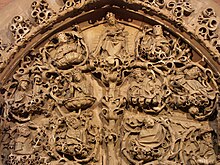
Relatively pocket-sized-scale Jesse Trees feature in prominent positions in many medieval churches, virtually notably nether a statue of St James on the central column of the famous main entrance (the Portico de la Gloria of 1168–88) of the Cathedral of Santiago de Compostela. Some other masterpiece of Romanesque rock-etching, the cloister of the Monastery of Santo Domingo de Silos, has a Tree on a flat panel carved in relief. Several 13th-century French cathedrals have Copse in the arches of doorways: Notre-Dame of Laon, Amiens Cathedral, and Chartres (fundamental arch, Northward portal - as well as the window). However these more often than not show the ancestors in archivolts on both sides of an arch, and although they are connected by tendrils, the coherence of the image is rather lost. Another popular way of showing the ancestry of Christ was to take a row or gallery of statues of the Kings of Judah (part of the ancestral line from Jesse) on the facade, equally at Notre Dame de Paris, but these as well go beyond the epitome of the Tree.[one] In a autograph version, a statue of the Virgin and Child on an entrance trumeau to Freiburg Minster is supported by a Jesse sleeping on a chair (c. 1300).[4]
Church of St Cuthbert, Wells, Somerset. St Cuthbert'south Church building formerly held a sculpted Tree of Jesse forming the reredos in its s transept, its components bundled effectually the east window. The contract survives, and shows that information technology was made in 1470 past John Stowell. It was destroyed during the Reformation or Interregnum, but the outline of the figure of Jesse is nevertheless visible, and many fragments of sculpture also survive.[29]
Christchurch Priory, Dorset. Christchurch Priory contains a boldly carved reredos in high-relief of the 1350s in the form of the Tree of Jesse. The figures of Jesse, King David and some other prophet all survive; and Christ is represented every bit part of a nascency scene.[30]
Wood carving [edit]
Priory Church of St Mary, Abergavenny, Wales. The Priory Church of St Mary, Abergavenny, formerly held a 15th-century composition, described by Thomas Churchyard in 1587 as "a most famous worke in maner of a genealogie of Kings, called the roote of Jesse".[31] By this date it had been destroyed during the Reformation, merely what survives is the larger than life-sized recumbent effigy of Jesse himself, carved from a single piece of oak. It has been described by Andrew Graham-Dixon as "the nigh impressive woods carving to have escaped the bonfires of the Reformation in Wales";[32] and by Phillip Lindley as "without doubt one of the finest pieces of fifteenth-century wood sculpture remaining in England or Wales".[33] It is unclear what form the rest of the tree originally took, just in 2016 a new stained-glass Jesse window designed by Helen Whittaker was installed in the church, incorporating the wooden Jesse at its foot.[34] [35]
Abbotsford House Chapel, Abbotsford, Nr Melrose, Borders, Scotland. The Chapel of Abbotsford House, congenital in 1855 past Sir Walter Scott'south granddaughter Charlotte, houses a Flemish Gothic carved and painted wooden chantry front of c. 1480, depicting the Tree of Jesse. It was purchased by her husband, James Hope-Scott.[36]
Church of Saint Francis, Porto, Portugal. An 18th-century Tree of Jesse carved in wood in Baroque style, it is three-dimensional and has coloured and aureate figures perched among its branches. Thirteen figures with the blackness disguised figure of Jesse lying on the bottom. The tree culminates with a picture of the Madonna and Child and a pigeon higher up them. On either side of the tree are other figures who appear to be either singing or reading from an open book which they are holding.[37]
Other pictural art [edit]

A comb from Bavaria, c. 1200
Ivory from Bavaria The rectangular back of an ivory comb (right) from Bavaria, from most 1200, is delicately carved with a Tree of Jesse scene, showing Jesse lying with the tree emerging from his bellybutton. 2 branches class a mandorla around the Blessed Virgin Mary who raises one hand to back up the infant Christ, while with her other, she holds a scroll. A prophet stands to either side.
San Zeno, Verona A bronze west door from the Basilica of St Zeno in Verona has a Tree in relief of about 1138 on a single console, with Jesse, Christ and iv ancestors.
St Mark's Basilica, Venice A large mosaic Tree was put on the north wall of the north transept in the 1540s, past the Bianchini brothers as mosaicists, post-obit a design past Salviati.
Monstrance from Augsburg A late 17th-century monstrance from Augsburg incorporates a version of the traditional blueprint, with Jesse comatose on the base, the tree equally the stem, and Christ and twelve ancestors arranged around the holder for the host.[4]
Cathedral Notre-Dame, Antwerp, Kingdom of belgium. An embroidered cope depicting the Tree of Jesse.[38]
Abbey Church, Buckfast Abbey, Devon
The church was rebuilt on medieval foundations between 1905 and 1937. The marble floor of the Lady chapel depicts the Tree of Jesse fabricated in the Abbey's own workshops in Byzantine mode mosaic.
The Church of the Nascency, Bethlehem, Palestinian Territories A large bas-relief of the Tree of Jesse by religious sculptor Czesław Dźwigaj was incorporated into the Church of St. Catherine within the Church of the Nascency in Bethlehem in 2009, equally the gift of Pope Benedict Sixteen during his trip to the Holy State. Measuring 3.25 metres broad by 4 metres high, its focus is an olive tree representing the Tree of Jesse, which displays Christ'due south lineage from Abraham to St. Joseph and other biblical motifs. Situated in the passage used by pilgrims making their mode to the Grotto of the Nativity, the bas-relief also incorporates symbolism from the One-time Attestation. The upper portion is dominated by a crowned figure of Christ the King posed with open up artillery approval the Earth.[39]
Poetry and music [edit]

The oldest complete Jesse Tree window is in Chartres Cathedral, 1145.
The symbolic device of the Tree of Jesse has featured in Christian hymns since at least the 8th century, when Cosmas the Melodist wrote a hymn almost the Virgin Mary flowering from the Root of Jesse, Ραβδος εκ της ριζης (translated in 1862 by John Mason Neale as "Rod of the Root of Jesse").[40] [41]
Virga Jesse floruit, an expression referring to the Virgin Mary and the birth of Christ,[42] put to music, east.g.,
- Every bit a Gradual:[43]
-
-
- (Alleluja, alleluja.)
- Virga Jesse floruit:
- Virgo Deum et hominem genuit:
- pacem Deus reddidit,
- in se reconcilians ima summis.
- Alleluja.
-
- William Byrd, included in his first book of Gradualia.[44]
- Virga Jesse past Anton Bruckner
-
- Equally office of a longer Christmas hymn, the text of which is given by Vopelius[45] and Spitta:[46]
-
-
- Virga Jesse floruit
- Emanuel noster apparuit
- Induit carnem hominis
- Fit puer delectabilis.
- Alleluja
-
- used in a Christmas cantata by Johann Kuhnau
- included in Magnificat in East-flat major, BWV 243a past Johann Sebastian Bach
-
In addition, the Tree of Jesse is besides referenced in the medieval series of lyrical poems known as the Cantigas de Santa Maria, written during the reign of Alfonso X in the thirteenth century. Cantiga 20, "Virga de Jesse" makes apply of the Tree of Jesse in the refrain of the vocal, farther demonstrating its influence on medieval culture and thought:
-
- Virga de Jésse
- quen te soubésse
- loar como mereces
- e sen ouvésse per
- que dissésse quanto
- por nós padeces.[47]
The symbol of the Virgin Mary equally a rose flowering from the Tree of Jesse forms the primal image of the 15th-century High german hymn, Es ist ein Ros entsprungen, commonly sung to a tune past Michael Praetorius. Various translations exist of this popular hymn, including Theodore Baker's "Lo, How a Rose E'er Blooming"(1894) and "A Spotless Rose" by Catherine Winkworth. Popular musical settings include works by Johannes Brahms and Herbert Howells.[41] [48] [49]
Modern use [edit]
The Christmas tree, and the Advent calendar, take been adapted in recent years by some mod Christians, who may use the term "Jesse Tree", although the tree does not unremarkably show Jesse or the Ancestors of Christ, and and then may have little or no relation to the traditional Tree of Jesse. This form is a poster or a existent tree in the church building or home, which over the course of Advent is busy with symbols to represent stories leading up to the Christmas story, for the benefit of children. The symbols are unproblematic, for case a called-for bush for Moses and a ram for Isaac.[l]
Image gallery [edit]
-

The beginning of the Gospel of Matthew from the Fécamp Bible shows the initial letter busy with a Jesse Tree
-

Scherenberg Psalter, c. 1260. Mary and Child, David and Solomon above, Isaiah and Jeremiah below. Notation the doves in the medallions.
-
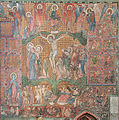
Wall painting c. 1380–90 from Toruń in Poland. Unusually, a Crucifixion occupies the middle of the Tree, with Christ in Glory above.
-
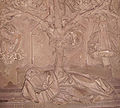
The bottom of a large stone relief from Worms Cathedral, cease of the 15th century, previously in the demolished cloister.
-

Michael Willmann 1678, Smooth, oil on canvas, "Family tree of Christ", Church Of The Assumption Of The Blessed Virgin Mary, Krzeszów.[51]
-

-

Rose window from the Basilica of St Denis, Paris, showing Jesse at the centre. This is not the earliest St Denis Jesse window, which is vertical similar Chartres.
-
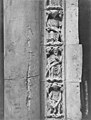
Plaster cast of the "Root of Jesse", originally from Westminster Abbey, Royal Architectural Museum, UK. Albumen print, c. 1874
-

Tree of Jesse on stained drinking glass windows of Virga Jesse Basilica, Hasselt (Belgium)
-

Holy church Maria of the Castle, Olivenza (Spain)
Encounter also [edit]
- Genealogy of Jesus
- Medieval art
- Poor Man'due south Bible
- Stained glass
- British and Irish gaelic stained drinking glass (1811–1918)
References [edit]
- ^ a b c d Émile Mâle, The Gothic Paradigm, Religious Art in France of the Thirteenth Century, p 165-8, English trans of tertiary edn, 1913, Collins, London (and many other editions)
- ^ Tree structure, Root directory
- ^ "Catholic Encyclopedia: Gilt Rose". Newadvent.org. 1909-09-01. Retrieved 2013-07-21 .
- ^ a b c d east f Chiliad Schiller, Iconography of Christian Fine art, Vol. I,1971 (English trans from German), Lund Humphries, London, p15-22 & figs 17-42, ISBN 0-85331-270-2
- ^ "CHURCH FATHERS: Sermon 24 (Leo the Great)". Newadvent.org . Retrieved 2013-07-21 .
- ^ Dodwell, 214-215
- ^ a b c d Jean Anne Hayes Williams. "The Earliest Dated Tree of Jesse File: Thematically reconsidered" (PDF). Fsu.edu. Archived from the original (PDF) on 2007-01-25.
- ^ Epistle to the Romans, Chapter 12: verses 6-8.
- ^ Dodwell, C.R.; The Pictorial arts of the West, 800-1200, pp. 193–four, 1993, Yale UP, ISBN 0-300-06493-four
- ^ Dodwell, pp. 211–215
- ^ Dijon, Public Library, Ms 12-15, and BnF, Paris Ms. lat 16746, f 7v, respectively. Both illustrated in Cahn, Walter, Romanesque Bible Illumination, Cornell UP, 1982, ISBN 0-8014-1446-vi
- ^ Pierpont Morgan Library 1000.43, f. 33v (Huntingfield Psalter); British Library Add MS 49622, f. eight. Both illustrated in Otto Pächt, Book Illumination in the Middle Ages (trans fr German), 1986, Harvey Miller Publishers, London, ISBN 0-19-921060-viii
- ^ "The Fitzwilliam Museum : Photo Gallery". Retrieved 2009-01-03 .
- ^ "Medieval Art and Compages". Vrcoll.fa.pitt.edu . Retrieved 2012-x-02 .
- ^ a b Sarah Brown, Stained Glass, an Illustrated History, Bracken books, ISBN 1-85891-157-five
- ^ Lawrence Lee, George Seddon, Francis Stephens, Stained Drinking glass, Spring Books, ISBN 0-600-56281-6
- ^ The Corona Chapel was built to hold the relic of the height of Becket's head, severed at the fourth dimension of his assassination.[ citation needed ]
- ^ a b Wells Cathedral website, Jesse Tree window Archived 2011-08-10 at the Wayback Auto, (retrieved 21-11-2013)
- ^ Dr Charles Kightly, Enjoy Medieval Denbighshire, pub. Denbighshire County Council.
- ^ Malcolm Low, The Tree of Jesse Directory, private publication.
- ^ Church Guide for St Mary of the Supposition Church.
- ^ The Kempe Society, Through the Looking Glass, courtesy, Hon. Secretary Philip Collins MSIAD.
- ^ Malcolm Depression, The Tree of Jesse Directory, quoting The Rev'd Clive Redknap.
- ^ G. E. Payne, The guide to All Saint'southward Church, Hove.
- ^ Geoff Sansome (2012-08-24). "St John Baptist Claines Church building Worcester". Clainesfriends.org.u.k.. Retrieved 2012-10-02 .
- ^ "Jesse Tree, Swavesey". flickr. Retrieved 25 December 2010.
- ^ Low, Malcolm (Jan 2006). "Swavesey, Cambridgeshire, St. Andrew'due south Church" (PDF). Tree of Jesse. Malcolm Low TSSF. p. 51. Archived from the original (PDF) on 2010-10-25.
- ^ "On the ceiling from Ely Cathedral" (PDF). Cathedral.ely.anglican.org . Retrieved 2012-10-02 .
- ^ Pevsner, Nikolaus (1958). North Somerset and Bristol. Buildings of England. Harmondsworth: Penguin. pp. 324–5. ISBN0-14-071013-2.
- ^ Goodall, John (17 Apr 2013). "Parish church building treasures: a wall of sculpture". Country Life. 207 (xvi): 66.
- ^ Churchyard, Thomas (1587). The Worthines of Wales. London. p. [F4]r–v.
- ^ Graham-Dixon, Andrew (1996). A History of British Art. London: BBC. pp. 24–ix. ISBN0-563-37044-0.
- ^ Deacon, Richard; Lindley, Phillip (2001). Epitome and Idol: medieval sculpture. London: Tate. pp. 50–51. ISBNi-85437-400-1.
- ^ "The Jesse Window explained". St Mary'south Priory, Abergavenny. xvi June 2016. Retrieved 9 September 2016.
- ^ Crampin, Martin (23 June 2016). "The Jesse Window explained". Stained glass from Welsh churches . Retrieved 9 September 2016.
- ^ Major-Full general Sir Walter Maxwell-Scott Bart. C.B., D.Due south.O., Guide to Abotsford, revised edition by Dr James Corson, Honorary Librarian of Abbotsford. Whiteholme Ltd, Dundee.
- ^ Malcolm Low, The Tree of Jesse Directory, quoting Ms Diane Cox.
- ^ Malcolm Low, The Tree of Jesse Directory, quoting Shelagh Addis.
- ^ "Płaskorzeźba due west darze" (in Smoothen). Dziennik Polski. 13 May 2009. Retrieved xix November 2013.
- ^ "Hymns of the Eastern Church". Christian Archetype Ethereal Library: 77. CiteSeerX10.one.one.693.1215.
- ^ a b Roth, Nancy (2001). "Hymn 81: Lo How a Rose eastward'er blooming". Praise, My Soul: Meditating on Hymns. Church Publishing, Inc. p. 11. ISBN9780898693744 . Retrieved 29 November 2017.
- ^ Nicholas J. Santoro. Mary In Our Life: Atlas of the Names and Titles of Mary, the Female parent of Jesus, and Their Place In Marian Devotion iUniverse, 2011. ISBN 1462040225 - ISBN 9781462040223 p. 656
- ^ Virga Jesse floruit at CPDL
- ^ Alleluia. Ave Maria - Virga Jesse floruit (William Byrd) at CPDL
- ^ Gottfried Vopelius. "Alia pia Cantio de Incarnatione Jesu Christi, à 4. Vocibus cum Basso continuo", pp. 77–83 in Neu Leipziger Gesangbuch. Leipzig: Christoph Klinger. 1682.
- ^ Philipp Spitta, translated by Clara Bell and J. A. Fuller Maitland. Johann Sebastian Bach: His Work and Influence on the Music of Deutschland, 1685–1750, in iii volumes. Novello & Co, 1899, Vol. ii, p. 371
- ^ Casson, Andrew. "Cantigas de Santa Maria for Singers". Cantigas de Santa Maria for Singers . Retrieved fourteen Apr 2018.
- ^ Owen, Barbara (2007). The Organ Music of Johannes Brahms. Oxford Academy Press, Usa. p. 104. ISBN9780195311075 . Retrieved 25 November 2017.
- ^ Coghlan, Alexandra (2016). Carols From King's. Random House. ISBN9781473530515 . Retrieved 29 November 2017.
- ^ "The Jesse Tree". crivoice.org. the Vocalization. Retrieved 19 February 2011.
- ^ English translation of Smoothen source - church in Krzeszów "i of the finest Bizarre churches in Europe."
Farther reading [edit]
- Gallino, Tilde Giani (1996). 50'albero di Jesse: l'immaginario collettivo medievale east la sessualità dissimulata (in Italian). Turin: Bollati Boringhieri. ISBN88-339-0979-4.
- Green, Susan Fifty. (2019). Tree of Jesse Iconography in Northern Europe in the Fifteenth and Sixteenth Centuries. New York: Routledge. ISBN9780815393771.
- Kirby, H. T. (1959–63). "The "Jesse" tree motif in stained glass: a comparative report of some English examples". Journal of the British Society of Master Glass-Painters. 13: 313–20, 434–41.
- Madranges, Étienne (2007). L'arbre de Jessé, de la racine à l'ésprit (in French). Paris: Bibliothèque des Introuvables. ISBN978-2-84575-294-eight. : mainly photographs
- Taylor, Michael D. (1980–81). "A historiated Tree of Jesse". Dumbarton Oaks Papers. 34–35: 125–76. doi:10.2307/1291450. JSTOR 1291450.
- Watson, Arthur (1934). The Early on Iconography of the Tree of Jesse. Oxford: Oxford University Press.
External links [edit]
- The Jesse Tree
- Jesse Tree: Ingeborg Psalter on "All Most Mary" The Academy of Dayton's Marian Library/International Marian Inquiry Institute (IMRI) is the globe's largest repository of books, artwork and artifacts devoted to Mary, the mother of Christ, and a pontifical eye of research and scholarship with a vast presence in internet.
- Bibliotheque nationale de French republic Mandragore database 12 illuminated examples at a good size. Press "Images" at correct.
- British Library manuscript image search 10 examples found past putting "Jesse" in "Image description" box. Many famous ones not included, & most enlargements seem non to work
- University of Cambridge (search on "Tree of Jesse")
- 4 examples from the Getty
- Chartres Cathedral; many good images of drinking glass and portal
- Various medieval works, including the original Saint Denis window, with many photos showing which parts are restored (click "France S. Denis")
- The Tree of Ballot: On the Symbolization of Spiritual Progress in Joachim of Fiore A text on medieval interpretations of the Jesse Tree past Matthias Riedl
- Tree of Jesse Directory: approx 300 references to the Tree of Jesse listed.
- Tree of Jesse plaster ceiling in Dartmouth Museum, believed to exist a unique example
Source: https://en.wikipedia.org/wiki/Tree_of_Jesse
Posted by: campbellthrecties61.blogspot.com
0 Response to "How Many Animals Are Carved Into The Tree Of Life"
Post a Comment