

What Type Of Animal Is The Title Character In The Beatrix Potter Story The Tale Of Tuppenny?
| Beatrix Potter | |
|---|---|
 Potter in 1913 | |
| Born | Helen Beatrix Potter (1866-07-28)28 July 1866 Westward Brompton, London, England |
| Died | 22 December 1943(1943-12-22) (anile 77) Near Sawrey, Lancashire (now Cumbria), England |
| Occupation | Children'southward writer and illustrator |
| Notable works | The Tale of Peter Rabbit |
| Spouse | William Heelis (m. 1913) |
| Relatives | Edmund Potter (grandfather) |
Helen Beatrix Potter (,[1] 28 July 1866 – 22 December 1943) was an English writer, illustrator, natural scientist, and conservationist. She is best known for her children's books featuring animals, such equally The Tale of Peter Rabbit.
Born into an upper-heart-grade household, Potter was educated by governesses and grew up isolated from other children. She had numerous pets and spent holidays in Scotland and the Lake Commune, developing a beloved of mural, flora and fauna, all of which she closely observed and painted.
Potter'south study and watercolours of fungi led to her being widely respected in the field of mycology. In her thirties, Potter self-published the highly successful children's volume The Tale of Peter Rabbit. Following this, Potter began writing and illustrating children'due south books total-time.
Potter wrote thirty books, the all-time known beingness her twenty-three children'southward tales. With the proceeds from the books and a legacy from an aunt, Potter bought Hill Pinnacle Subcontract in Near Sawrey in 1905; this is a hamlet in the Lake Commune in the historic county of Lancashire. Over the following decades, she purchased boosted farms to preserve the unique loma state landscape. In 1913, at the age of 47, she married William Heelis, a respected local solicitor from Hawkshead. Potter was also a prize-winning breeder of Herdwick sheep and a prosperous farmer keenly interested in land preservation. She continued to write and illustrate, and to design spin-off merchandise based on her children's books for British publisher Warne until the duties of land management and her diminishing eyesight fabricated it difficult to continue.
Potter died of pneumonia and heart disease on 22 December 1943 at her dwelling house in Nearly Sawrey at the historic period of 77, leaving almost all her holding to the National Trust. She is credited with preserving much of the land that now constitutes the Lake Commune National Park. Potter's books continue to sell throughout the world in many languages with her stories beingness retold in songs, films, ballet, and animations, and her life is depicted in two films and a television series.
Biography [edit]
Early life [edit]
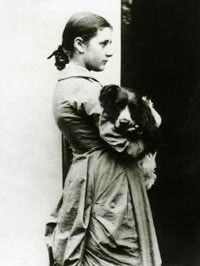
Potter'south family unit on both sides were from the Manchester area.[2] They were English Unitarians,[3] associated with dissenting Protestant congregations, influential in 19th century England, that affirmed the oneness of God and that rejected the doctrine of the Trinity. Potter's paternal grandfather, Edmund Potter, from Glossop in Derbyshire, owned what was and then the largest calico printing works in England, and later served as a Fellow member of Parliament.[four]
Potter'southward father, Rupert William Potter (1832–1914), was educated at Manchester College by the Unitarian philosopher James Martineau.[5] [6] He then trained every bit a barrister in London. Rupert practised law, specialising in equity law and conveyancing. He married Helen Leech (1839–1932) on 8 August 1863 at Hyde Unitarian Chapel, Gee Cross. Helen was the girl of Jane Ashton (1806–1884) and John Leech, a wealthy cotton merchant and shipbuilder from Stalybridge. Helen's first cousins were siblings Harriet Lupton (née Ashton) and Thomas Ashton, 1st Baron Ashton of Hyde. It was reported in July 2014 that Potter had personally given a number of her own original paw-painted illustrations to the two daughters of Arthur and Harriet Lupton, who were cousins to both Beatrix Potter and Catherine, Duchess of Cambridge.[5] [7]
Potter's parents lived comfortably at 2 Bolton Gardens, W Brompton, where Helen Beatrix was born on 28 July 1866 and her brother Walter Bertram on 14 March 1872.[8] The house was destroyed in the Blitz. Bousfield Main School now stands where the house one time was. A blueish plaque on the school building testifies to the former site of the Potter home.[9] Both parents were artistically talented,[10] and Rupert was an adept amateur lensman.[11] [12] Rupert had invested in the stock marketplace, and past the early on 1890s, he was extremely wealthy.[13]
Beatrix Potter was educated past three governesses, the last of whom was Annie Moore (née Carter), just iii years older than Potter, who tutored Potter in German as well every bit acting equally lady'southward companion.[14] She and Potter remained friends throughout their lives, and Annie'southward 8 children were the recipients of many of Potter's picture letters. It was Annie who later suggested that these letters might make good children'due south books.[fifteen]
She and her younger blood brother Walter Bertram (1872–1918) grew up with few friends outside their large extended family. Her parents were artistic, interested in nature, and enjoyed the countryside. Equally children, Potter and Bertram had numerous small animals as pets which they observed closely and drew incessantly. In their schoolroom, Potter and Bertram kept a variety of pocket-size pets—mice, rabbits, a hedgehog and some bats, along with collections of collywobbles and other insects—which they drew and studied.[16] Potter was devoted to the care of her small animals, often taking them with her on long holidays.[17] In nearly of the first fifteen years of her life, Potter spent summer holidays at Dalguise, an estate on the River Tay in Perthshire, Scotland. There she sketched and explored an area that nourished her imagination and her observation.[eighteen] Her first sketchbook from those holidays, kept at historic period 8, and dated 1875, is held at and been digitised by the Victoria & Albert Museum, London.[xix] Potter and her blood brother were allowed dandy liberty in the country, and both children became expert students of natural history. In 1882, when Dalguise was no longer available, the Potters took their get-go summer holiday in the Lake District, at Wray Castle almost Lake Windermere.[20] Here Potter met Hardwicke Rawnsley, vicar of Wray and later the founding secretary of the National Trust, whose interest in the countryside and country life inspired the same in Potter and who was to have a lasting bear upon on her life.[21] [22]
At about the age of 14, Potter began to keep a diary. It was written in a code of her own devising which was a simple letter for letter commutation. Her Journal was of import to the development of her inventiveness, serving as both sketchbook and literary experiment: in tiny handwriting, she reported on guild, recorded her impressions of art and artists, recounted stories and observed life around her.[23] The Journal, decoded and transcribed by Leslie Linder in 1958, does non provide an intimate record of her personal life, just it is an invaluable source for understanding a vibrant part of British society in the late 19th century. It describes Potter'south maturing artistic and intellectual interests, her often amusing insights on the places she visited, and her unusual ability to detect nature and to describe it. Started in 1881, her journal ends in 1897 when her artistic and intellectual energies were absorbed in scientific report and in efforts to publish her drawings.[24] Precocious but reserved and often bored, she was searching for more independent activities and wished to earn some money of her own while dutifully taking care of her parents, dealing with her especially demanding mother,[25] and managing their various households.
Scientific illustrations and work in mycology [edit]
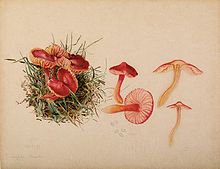
Beatrix Potter's parents did not discourage higher education. As was common in the Victorian era, women of her course were privately educated and rarely went to academy.[26]
Beatrix Potter was interested in every branch of natural science except astronomy.[27] Botany was a passion for most Victorians and nature study was a pop enthusiasm. She collected fossils,[28] studied archaeological artefacts from London excavations, and was interested in entomology. In all these areas, she drew and painted her specimens with increasing skill. Past the 1890s, her scientific interests centred on mycology. Showtime drawn to fungi considering of their colours and evanescence in nature and her delight in painting them, her interest deepened after coming together Charles McIntosh, a revered naturalist and amateur mycologist, during a summertime holiday in Dunkeld in Perthshire in 1892. He helped amend the accuracy of her illustrations, taught her taxonomy, and supplied her with live specimens to paint during the winter. Curious equally to how fungi reproduced, Potter began microscopic drawings of mucus spores (the agarics) and in 1895 adult a theory of their germination.[29] Through the connections of her uncle Sir Henry Enfield Roscoe, a chemist and vice-chancellor of the University of London, she consulted with botanists at Kew Gardens, disarming George Massee of her ability to germinate spores and her theory of hybridisation.[30] She did not believe in the theory of symbiosis proposed past Simon Schwendener, the German mycologist, every bit previously idea; instead, she proposed a more independent process of reproduction.[31]
Rebuffed by William Thiselton-Dyer, the Manager at Kew, because of her sex activity and her amateur status, Potter wrote upwards her conclusions and submitted a paper, On the Germination of the Spores of the Agaricineae, to the Linnean Society in 1897. It was introduced by Massee because, as a female, Potter could not attend proceedings or read her newspaper. She afterward withdrew it, realising that some of her samples were contaminated, but continued her microscopic studies for several more years. Her paper has but recently been rediscovered, along with the rich, artistic illustrations and drawings that accompanied it. Her work is only at present being properly evaluated.[32] [33] [34] Potter later gave her other mycological and scientific drawings to the Armitt Museum and Library in Ambleside, where mycologists still refer to them to identify fungi. There is too a collection of her fungus paintings at the Perth Museum and Art Gallery in Perth, Scotland, donated past Charles McIntosh. In 1967, the mycologist W.P.K. Findlay included many of Potter's beautifully accurate fungus drawings in his Wayside & Woodland Fungi, thereby fulfilling her desire to one twenty-four hour period have her fungus drawings published in a book.[35] In 1997, the Linnean Guild issued a posthumous apology to Potter for the sexism displayed in its treatment of her enquiry.[36]
Artistic and literary career [edit]

Potter's artistic and literary interests were deeply influenced past fairy tales and fantasy. She was a student of the classic fairy tales of Western Europe. Also equally stories from the Onetime Attestation, John Bunyan'due south The Pilgrim's Progress and Harriet Beecher Stowe's Uncle Tom's Cabin, she grew upwardly with Aesop'south Fables, the fairy tales of the Brothers Grimm and Hans Christian Andersen, Charles Kingsley'south The Water Babies,[37] the folk tales and mythology of Scotland, the High german Romantics, Shakespeare,[38] and the romances of Sir Walter Scott.[39] As a young kid, before the age of eight, Edward Lear'south A Book of Nonsense, including the much loved The Owl and the Pussycat, and Lewis Carroll'south Alice in Wonderland had fabricated their impression, although she later said of Alice that she was more interested in Tenniel's illustrations than what they were about.[twoscore] The Brer Rabbit stories of Joel Chandler Harris had been family favourites, and she afterwards studied his Uncle Remus stories and illustrated them.[41] She studied volume illustration from a young historic period and developed her own tastes, but the work of the pic book triumvirate Walter Crane, Kate Greenaway and Randolph Caldecott, the concluding an illustrator whose work was subsequently collected past her male parent, was a smashing influence.[42] When she started to illustrate, she chose first the traditional rhymes and stories, "Cinderella", "Sleeping Beauty", "Ali Baba and the Forty Thieves", "Puss-in-boots", and "Cherry-red Riding Hood".[43] Even so, most oftentimes her illustrations were fantasies featuring her own pets: mice, rabbits, kittens, and guinea pigs.[44]
In her teenage years, Potter was a regular visitor to the art galleries of London, especially enjoying the summer and winter exhibitions at the Royal Academy in London.[45] Her Journal reveals her growing composure as a critic besides as the influence of her male parent'due south friend, the artist Sir John Everett Millais, who recognised Potter'south talent of ascertainment. Although Potter was aware of art and artistic trends, her cartoon and her prose way were uniquely her own.[46]
As a way to earn money in the 1890s, Potter and her brother began to print Christmas cards of their own design, besides every bit cards for special occasions. Mice and rabbits were the most frequent subject field of her fantasy paintings. In 1890, the firm of Hildesheimer and Faulkner bought several of the drawings of her rabbit Benjamin Bunny to illustrate verses by Frederic Weatherly titled A Happy Pair. In 1893, the aforementioned printer bought several more than drawings for Weatherly's Our Dear Relations, another book of rhymes, and the following twelvemonth Potter sold a series of frog illustrations and verses for Changing Pictures, a popular annual offered past the fine art publisher Ernest Nister. Potter was pleased by this success and determined to publish her own illustrated stories.[47]
Whenever Potter went on vacation to the Lake District or Scotland, she sent messages to immature friends, illustrating them with quick sketches. Many of these letters were written to the children of her former governess Annie Carter Moore, peculiarly to Moore's eldest son Noel, who was often ill. In September 1893, Potter was on vacation at Eastwood in Dunkeld, Perthshire. She had run out of things to say to Noel, and so she told him a story about "four piffling rabbits whose names were Flopsy, Mopsy, Cottontail and Peter". It became one of the well-nigh famous children's letters always written and the ground of Potter's futurity career as a writer-creative person-storyteller.[48]

Potter's dummy manuscripts of iii of her books – designed to see how the printed book would look
In 1900, Potter revised her tale about the four little rabbits, and fashioned a dummy book of it – it has been suggested, in fake of Helen Bannerman's 1899 bestseller The Story of Piffling Black Sambo.[49] Unable to find a buyer for the work, she published it for family and friends at her ain expense in December 1901. It was drawn in black and white with a coloured frontispiece. Rawnsley had great faith in Potter's tale, recast it in didactic verse, and made the rounds of the London publishing houses. Frederick Warne & Co had previously rejected the tale but, eager to compete in the booming small-scale format children's book marketplace, reconsidered and accepted the "bunny book" (as the firm chosen it) post-obit the recommendation of their prominent children's volume artist 50. Leslie Brooke.[l] The business firm declined Rawnsley's poetry in favour of Potter'southward original prose, and Potter agreed to color her pen and ink illustrations, choosing the then-new Hentschel 3-color process to reproduce her watercolours.[51]

Potter used many real locations for her book illustrations. The Tower Depository financial institution Arms, About Sawrey appears in The Tale of Jemima Puddle-Duck.
On 2 October 1902, The Tale of Peter Rabbit was published,[52] and was an immediate success. It was followed the next year by The Tale of Squirrel Nutkin and The Tailor of Gloucester, which had as well commencement been written every bit picture letters to the Moore children. Working with Norman Warne as her editor, Potter published two or iii footling books each yr: 23 books in all. The last book in this format was Cecily Parsley's Nursery Rhymes in 1922, a collection of favourite rhymes. Although The Tale of Petty Pig Robinson was not published until 1930, information technology had been written much earlier. Potter continued creating her footling books until after the First World War when her energies were increasingly directed toward her farming, sheep-breeding and land conservation.[53]
The immense popularity of Potter's books was based on the lively quality of her illustrations, the non-didactic nature of her stories, the depiction of the rural countryside, and the imaginative qualities she lent to her beast characters.[54] [55]
Potter was as well a canny businesswoman. As early equally 1903, she made and patented a Peter Rabbit doll. It was followed by other "spin-off" merchandise over the years, including painting books, lath games, wall-newspaper, figurines, infant blankets and communist china tea-sets. All were licensed by Frederick Warne & Co and earned Potter an independent income, as well equally immense profits for her publisher.[56]
In 1905, Potter and Norman Warne became unofficially engaged. Potter's parents objected to the match considering Warne was "in trade" and thus not socially suitable. The appointment lasted only one month—Warne died of pernicious anaemia at age 37.[57] That same yr, Potter used some of her income and a small inheritance from an aunt to buy Colina Top Farm in Near Sawrey in the English Lake District near Windermere. Potter and Warne may have hoped that Hill Top Farm would be their holiday habitation, but after Warne's death, Potter went alee with its buy equally she had always wanted to own that farm, and live in "that charming hamlet".[58]
Country life and marriage [edit]

Colina Top, Near Sawrey – Potter's quondam home, now owned by the National Trust and preserved equally it was when she lived and wrote her stories in that location.
The tenant farmer John Cannon and his family unit agreed to stay on to manage the farm for her while she made physical improvements and learned the techniques of fell farming and of raising livestock, including pigs, cows and chickens; the post-obit yr she added sheep. Realising she needed to protect her boundaries, she sought advice from W.H. Heelis & Son, a local house of solicitors with offices in nearby Hawkshead. With William Heelis acting for her, she bought face-to-face pasture, and in 1909 the 20 acres (8.1 ha) Castle Farm across the road from Hill Superlative Farm. She visited Hill Superlative at every opportunity, and her books written during this period (such equally The Tale of Ginger and Pickles, about the local shop in About Sawrey and The Tale of Mrs. Tittlemouse, a wood mouse) reverberate her increasing participation in village life and her delight in country living.[59]
Owning and managing these working farms required routine collaboration with the widely respected William Heelis. Past the summertime of 1912, Heelis had proposed marriage and Potter had accepted; although she did not immediately tell her parents, who over again disapproved considering Heelis was only a country solicitor. Potter and Heelis were married on 15 October 1913 in London at St Mary Abbots in Kensington. The couple moved immediately to Near Sawrey, residing at Castle Cottage, the renovated farmhouse on Castle Subcontract, which was 34 acres big. Hill Acme remained a working farm but was at present remodelled to allow for the tenant family and Potter'south individual studio and workshop. At last her ain woman, Potter settled into the partnerships that shaped the residue of her life: her country solicitor hubby and his big family, her farms, the Sawrey community and the predictable rounds of land life. The Tale of Jemima Puddle-Duck and The Tale of Tom Kitten are representative of Hill Top Farm and her farming life and reverberate her happiness with her country life.[60]
Rupert Potter died in 1914 and, with the outbreak of Earth State of war I, Potter, now a wealthy woman, persuaded her mother to motility to the Lake District and found a property for her to rent in Sawrey. Finding life in Sawrey dull, Helen Potter soon moved to Lindeth Howe (now a 34 bedroomed hotel) a big house the Potters had previously rented for the summer in Bowness, on the other side of Lake Windermere,[61] Potter connected to write stories for Frederick Warne & Co and fully participated in state life. She established a Nursing Trust for local villages and served on various committees and councils responsible for footpaths and other rural bug.[62]
Sheep farming [edit]
Soon later acquiring Loma Top Subcontract, Potter became keenly interested in the breeding and raising of Herdwick sheep, the indigenous roughshod sheep. In 1923 she bought a large sheep farm in the Troutbeck Valley called Troutbeck Park Farm, formerly a deer park, restoring its land with thousands of Herdwick sheep. This established her every bit one of the major Herdwick sheep farmers in the canton. She was admired by her shepherds and farm managers for her willingness to experiment with the latest biological remedies for the common diseases of sheep, and for her employment of the best shepherds, sheep breeders, and subcontract managers.[63]
By the late 1920s, Potter and her Hill Tiptop farm director Tom Storey had made a name for their prize-winning Herdwick flock, which took many prizes at the local agricultural shows, where Potter was ofttimes asked to serve as a judge. In 1942 she became President-elect of the Herdwick Sheepbreeders' Association, the first fourth dimension a woman had been elected merely died earlier taking office.[64]
Lake District conservation [edit]
Potter had been a disciple of the land conservation and preservation ideals of her long-time friend and mentor, Canon Hardwicke Rawnsley, the first secretarial assistant and founding member of the National Trust for Places of Historic Interest or Natural Beauty.[65] According to the National Trust, "she supported the efforts of the National Trust to preserve not just the places of boggling dazzler but also those heads of valleys and low grazing lands that would be irreparably ruined past development." Potter was also an authorisation on the traditional Lakeland crafts and period piece of furniture,[66] as well as local stonework. She restored and preserved the farms that she bought or managed, making certain that each farm business firm had in information technology a piece of antiquarian Lakeland furniture. Potter was interested in preserving not only the Herdwick sheep simply likewise the way of life of fell farming.[67] In 1930 the Heelises became partners with the National Trust in ownership and managing the roughshod farms included in the large Monk Coniston Estate.[68] The estate was composed of many farms spread over a wide area of north-western Lancashire, including the Tarn Hows. Potter was the de facto manor manager for the Trust for seven years until the National Trust could afford to repurchase nearly of the property from her. Potter'due south stewardship of these farms earned her full regard, just she was not without her critics, not the least of which were her contemporaries who felt she used her wealth and the position of her husband to acquire properties in accelerate of their beingness fabricated public. She was notable in observing the issues of afforestment, preserving the intact grazing lands, and husbanding the quarries and timber on these farms. All her farms were stocked with Herdwick sheep and frequently with Galloway cattle.

Later life [edit]
Potter continued to write stories and to describe, although by and large for her own pleasance. Her books in the belatedly 1920s included the semi-autobiographical The Fairy Caravan, a fanciful tale fix in her beloved Troutbeck fells. Information technology was published simply in the US during Potter'southward lifetime, and not until 1952 in the United kingdom. Sister Anne, Potter'due south version of the story of Bluebeard, was written for her American readers, merely illustrated by Katharine Sturges. A terminal folktale, Wag by Wall, was published posthumously by The Horn Book Mag in 1944. Potter was a generous patron of the Daughter Guides, whose troupes she allowed to make their summer encampments on her land, and whose company she enjoyed as an older woman.[69]
Potter and William Heelis enjoyed a happy marriage of thirty years, continuing their farming and preservation efforts throughout the hard days of World War Two. Although they were childless, Potter played an of import role in William's big family, especially enjoying her relationship with several nieces whom she helped brainwash, and giving condolement and aid to her husband'due south brothers and sisters.[70]
Potter died of complications from pneumonia and heart illness on 22 December 1943 at Castle Cottage, and her remains were cremated at Carleton Crematorium, Blackpool. She left nearly all her property to the National Trust, including over 4,000 acres (xvi kmtwo) of land, sixteen farms, cottages and herds of cattle and Herdwick sheep. Hers was the largest souvenir at that time to the National Trust, and information technology enabled the preservation of the country now included in the Lake District National Park and the continuation of vicious farming. The primal office of the National Trust in Swindon was named "Heelis" in 2005 in her retentiveness.
William Heelis continued his stewardship of their properties and of her literary and artistic piece of work for the xx months he survived her. When he died in August 1945, he left the rest to the National Trust.[71]
Legacy [edit]
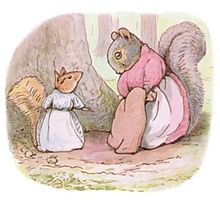
Goody and Mrs. Hackee, illustration to The Tale of Timmy Tiptoes, 1911
Potter left virtually all the original illustrations for her books to the National Trust. The copyright to her stories and merchandise was then given to her publisher Frederick Warne & Co, now a sectionalisation of the Penguin Group. On one January 2014, the copyright expired in the United kingdom of great britain and northern ireland and other countries with a seventy-years-afterwards-decease limit. Hill Top Farm was opened to the public past the National Trust in 1946; her artwork was displayed there until 1985 when it was moved to William Heelis's quondam law offices in Hawkshead, also owned by the National Trust as the Beatrix Potter Gallery.[72]
Potter gave her folios of mycological drawings to the Armitt Library and Museum in Ambleside before her death. The Tale of Peter Rabbit is endemic past Frederick Warne and Company, The Tailor of Gloucester by the Tate Gallery, and The Tale of the Flopsy Bunnies by the British Museum.[73]
The largest public collection of her letters and drawings is the Leslie Linder Bequest and Leslie Linder Collection at the Victoria and Albert Museum in London. (Linder was the collector who—subsequently five years of work—finally transcribed Potter'due south early journal, originally written in lawmaking.) In the Usa, the largest public collections are those in the Rare Book Department[74] of the Costless Library of Philadelphia, and the Cotsen Children's Library at Princeton University.
In 2015 a manuscript for an unpublished book was discovered past Jo Hanks, a publisher at Penguin Random House Children's Books, in the Victoria and Albert Museum archive. The volume The Tale of Kitty-in-Boots, with illustrations by Quentin Blake,[75] was published 1 September 2016, to marking the 150th anniversary of Potter'due south birth.[76]
In 2017, The Fine art of Beatrix Potter: Sketches, Paintings, and Illustrations by Emily Zach was published subsequently San Francisco publisher Chronicle Books decided to mark the 150th ceremony of Beatrix Potter's birth by showing that she was "far more than a 19th-century weekend painter. She was an artist of astonishing range."[77]
In December 2017, the asteroid 13975 Beatrixpotter, discovered past Belgian astronomer Eric Elst in 1992, was named in her retentivity.[78]
In 2022, an exhibition Beatrix Potter: Drawn to Nature was held at the Victoria and Albert Museum. Research for the exhibition identified the human's court waistcoat c. 1780s, which inspired Potter'south sketch in 'The Tailor of Gloucester'.[79]
Analysis [edit]
There are many interpretations of Potter'due south literary work, the sources of her art, and her life and times. These include critical evaluations of her corpus of children's literature and Modernist interpretations of Humphrey Carpenter and Katherine Chandler. Judy Taylor, That Naughty Rabbit: Beatrix Potter and Peter Rabbit (rev. 2002) tells the story of the first publication and many editions.[80]
Potter'southward country life and her farming accept been discussed in the work of Susan Denyer and other authors in the publications of The National Trust, such as Beatrix Potter at Home in the Lake Commune (2004).[81]
Potter's work as a scientific illustrator and her work in mycology are discussed in Linda Lear's books Beatrix Potter: A Life in Nature (2006)[82] and Beatrix Potter: The Extraordinary Life of a Victorian Genius (2008).[83] [84]
Adaptations [edit]
In 1971, a ballet flick was released, The Tales of Beatrix Potter, directed by Reginald Mills, ready to music by John Lanchbery with choreography by Frederick Ashton, and performed in graphic symbol costume by members of the Purple Ballet and the Royal Opera Business firm orchestra.[85] The ballet of the aforementioned name has been performed by other dance companies around the world.[86]
In 1992, Potter'southward children's book The Tale of Benjamin Bunny was featured in the film Lorenzo'due south Oil.[87]
Potter is also featured in Susan Wittig Albert's series of lite mysteries called The Cottage Tales of Beatrix Potter. The first of the eight-book serial is Tale of Colina Pinnacle Farm (2004), which deals with Potter's life in the Lake District and the hamlet of Near Sawrey between 1905 and 1913.[88]
In film [edit]
In 1982, the BBC produced The Tale of Beatrix Potter. This dramatization of her life was written past John Hawkesworth, directed by Bill Hayes, and starred Holly Aird and Penelope Wilton as the young and adult Potter, respectively. The World of Peter Rabbit and Friends, a Tv set series based on nine of her twenty-4 stories, which starred actress Niamh Cusack every bit Beatrix Potter.[89]
In 1993, Weston Forest Studios made an almost hour non-story film called "Beatrix Potter: Artist, Storyteller, and Countrywoman" with narration by Lynn Redgrave and music past Ernest Troost.
In 2006, Chris Noonan directed Miss Potter, a biographical picture show of Potter'southward life focusing on her early career and romance with her editor Norman Warne. The film stars Renée Zellweger, Ewan McGregor and Emily Watson.[90]
On 9 February 2018, Columbia Pictures released Peter Rabbit, directed by Will Gluck, based on the work past Potter.[91] The character Bea, played past Rose Byrne, is a re-imagined version of Potter.[92] A sequel to the motion picture titled Peter Rabbit two: The Runaway was released in 2021.[93]
On 24 December 2020, Sky 1 premiered Roald & Beatrix: The Tail of the Curious Mouse, a made-for-television drama film[94] [95] [96] inspired past the true story of a 6-twelvemonth-old Roald Dahl meeting his idol Potter. Set in 1922, the movie was written by Abigail Wilson, directed by David Kerr and starred Dawn French equally Beatrix Potter, Rob Brydon every bit William Heelis and Jessica Hynes as Sofie Dahl. Filming took place in Wales (the birthland of Roald Dahl, French and Brydon), during the COVID-19 pandemic. This product incorporates live action, stop movement and puppetry. The DVD was released 26 April 2021.
Publications [edit]
The 23 Tales [edit]
- The Tale of Peter Rabbit (privately printed, 250 copies, 1901)
- The Tale of Peter Rabbit (1902)
- The Tale of Squirrel Nutkin (1903)
- The Tailor of Gloucester (1903)
- The Tailor of Gloucester (privately printed, 250 copies, 1902)
- The Tale of Benjamin Bunny (1904)
- The Tale of Two Bad Mice (1904)
- The Tale of Mrs. Tiggy-Winkle (1905)
- The Tale of the Pie and the Patty-Pan (1905)
- The Tale of Mr. Jeremy Fisher (1906)
- The Story of a Fierce Bad Rabbit (1906)
- The Story of Miss Moppet (1906)
- The Tale of Tom Kitten (1907)
- The Tale of Jemima Puddle-Duck (1908)
- The Tale of Samuel Whiskers or, The Roly-Poly Pudding (1908)
- The Tale of the Flopsy Bunnies (1909)
- The Tale of Ginger and Pickles (1909)
- The Tale of Mrs. Tittlemouse (1910)
- The Tale of Timmy Tiptoes (1911)
- The Tale of Mr. Tod (1912)
- The Tale of Pigling Bland (1913)
- Appley Dapply's Plant nursery Rhymes (1917)
- The Tale of Johnny Town-Mouse (1918)
- Cecily Parsley's Nursery Rhymes (1922)
- The Tale of Little Pig Robinson (1930)
Other books [edit]
- Peter Rabbit's Painting Book (1911)
- Tom Kitten's Painting Book (1917)
- Jemima Pool-Duck's Painting Book (1925)
- Peter Rabbit's Almanac for 1929 (1928)
- The Fairy Caravan (1929)
- Sister Anne (illustrated by Katharine Sturges) (1932)
- Wag-by-Wall (decorations by J. J. Lankes) (1944)
- The Tale of the Faithful Dove (illustrated past Marie Angel) (1955, 1970)
- The Sly Old Cat (written 1906; first published 1971)
- The Tale of Tuppenny (illustrated by Marie Angel) (1973)
- The Tale of Kitty-in-Boots (2016)[75] (Illustrated past Quentin Blake.)
- Scarlet Riding Hood (2019) (Illustrated past Helen Oxenbury.)
References [edit]
- ^ "Costless online Dictionary of English Pronunciation – How to Pronounce English words". howjsay.com. Archived from the original on 21 August 2021. Retrieved 6 Oct 2017.
- ^ Lear 2007, p. ten
- ^ Lear 2007, p. 9
- ^ Lear 2007, pp. x–xiv
- ^ a b Walker, Tim (22 July 2014). "Mandrake-The Duchess of Cambridge is related to Potter, who in one case gave the Middleton family unit her own original paw-painted illustrations". The Daily Telegraph. London. p. eight. Archived from the original on 16 June 2019. Retrieved 16 August 2014.
- ^ Taylor, Judy (1996). "Beatrix Potter – Artist, Storyteller". Frederick Warne. Archived from the original on 16 January 2014. Retrieved xv Jan 2014.
- ^ Evening Mail, NW (21 July 2014). "Cumbria author Beatrix Potter link to Prince George revealed". North-Westward Evening Post. Archived from the original on 28 July 2014. Retrieved xvi August 2014.
- ^ Lear 2007, pp. 13–24
- ^ "Beatrix Potter's London". Londonist.com. 26 Jan 2016. Archived from the original on 31 Oct 2018. Retrieved xix September 2017.
- ^ Lear 2007, p. 21
- ^ Lear 2007, pp. 35–36
- ^ Rupert Potter was a fellow member of the Photographic Society, later Purple Photographic Gild from 1869 until 1912. Data from Michael Pritchard, Director-General / www.rps.org Archived 2 April 2014 at the Wayback Machine, 13 May 2014.
- ^ Lear 2007, p. 19. Rupert came into his father's manor over the course of several years, 1884, 1891 and 1905. The Potters were comfortable but they did not live exclusively on inherited wealth; Lane, (1946) The Tale of Beatrix Potter 1946, p. 1
- ^ Lear 2007, p. 55
- ^ Lear 2007, p. 142; Lane, 1978, The Magic Years of Potter Potter. Lane depicts Potter's childhood as much more restricted than either or Potter'southward two later biographers. Taylor, Beatrix Potter: Artist Story Teller, Ch 1.; Lear, 2007, pp. 25–48; Beatrix Potter, The Journal of Beatrix Potter: From 1881–1897.
- ^ Lear 2007, p. 31, pp. 37–44, p. 458nn15
- ^ Judy Taylor, Joyce Irene Whalley, Anne Stevenson Hobbs and Elizabeth Battrick, (1987) Beatrix Potter, 1866–1943: The Artist and Her World, pp.9–17, 35–48; Lear, pp. 25–48.
- ^ Lear 2007, pp. 26–eight, 51
- ^ "5&A · Beatrix Potter'due south first sketchbook, aged viii". Victoria and Albert Museum . Retrieved eleven May 2022.
- ^ Lear 2007, pp. 51–2
- ^ Potter, The Journal, 1885–1897
- ^ Lear 2007, pp. 52–three
- ^ Lear 2007, pp.49–51 cf. as well p. 463nn1
- ^ Potter, "The Journal, 1885–1897"
- ^ Lear 2007, p. 94 also cf. p. 474nn55
- ^ Taylor, Artist, Storyteller, pp. 59–61; Elizabeth Eastward. Battrick, (1999) Beatrix Potter: The Unknown Years; Lynn Barber, (1980) The Heyday of Natural History, Brian Gardiner, "Breatrix Potter's Fossils and Her Interests in Geology", The Linnean, 16/1 (January 2000), 31–47; Lear 2007, pp. 76–103; Potter, Periodical, 1891–1897.
- ^ Lear 2007, p. 98
- ^ Brian K. Gardiner, "Beatrix Potter's fossils and her interest in Geology," The Linnean: Newsletter and Proceedings of the Linnean Social club of London sixteen/1 (January 2000), pp. 31–47
- ^ Lear 2007, pp. 81–103
- ^ Lear 2007, p. 117
- ^ Thousand.A. Taylor and R.H. Rodger, eds. (2003) A Fascinating Acquaintance: Charles McIntosh and Beatrix Potter; Taylor, et al. (1987) Artist and Her Earth, pp. 71–94; Lear 2007, pp. 104–129; Nicholas P. Money, "Beatrix Potter, Victorian Mycologist", Fungi. 2:four (Autumn 2009); Roy Watling, "Helen Beatrix Potter: Her interest in fungi", The Linnean: Newsletter and Proceedings of the Linnean Society of London, sixteen/ane (Jan 2000), pp. 24–31.
- ^ "Beatrix Potter and the Linnean Society". Linnean Society. Archived from the original on 9 November 2011. Retrieved 1 November 2011.
- ^ Lear 2007, pp. 104–25
- ^ Watling, Roy (January 2000). "Helen Beatrix Potter: Her interest in fungi" (PDF). The Linnean: Newsletter and Proceedings of the Linnean Society of London. pp. 24–31. Archived from the original (PDF) on 13 May 2013.
- ^ Walter Philip Kennedy Findlay, (1967) Wayside & Woodland Fungi
- ^ Lear 2007, p. 125, p.482nn58
- ^ Lear 2007, pp. thirty–i
- ^ Lear 2007, p. 95. She liked to memorise his plays by eye.
- ^ Lear 2007, p. 35. Beatrix said she learnt to read "on" Scott
- ^ Lear 2007, p. 34
- ^ Lear 2007, p.131. She began eight Uncle Remus drawings in the same year 1893 she began writing the Peter Rabbit picture letters to Noel Moore, completing the last in 1896.
- ^ Lear 2007, p. 33
- ^ Lear 2007, pp. 127–8
- ^ Taylor, et al., The Artist and her World, pp. 49–70; Potter, Journal, 1884–1897; Humphrey Carpenter (1985), Cloak-and-dagger Gardens: The Gilded Historic period of Children's Literature.
- ^ Lear 2007, p. 47-viii. J. G. W. Turner was the kickoff artist to impress her.
- ^ Taylor, Artist, Storyteller, pp. 70–95; Taylor, ed. 1989, Beatrix Potters Letters.
- ^ Taylor, et al. 1987, pp. 107–148; Katherine Chandler, "Thoroughly Post-Victorian, Pre-Modern Beatrix." Children's Literature Quarterly. 32(iv): 287–307.
- ^ Judy Taylor 1992, Letters to Children from Beatrix Potter.
- ^ Stevenson, Laura C. "A Faddy for Small Books": The Tale of Peter Rabbit and its Contemporary Competitors" [1] Archived 22 March 2012 at the Wayback Auto
- ^ Lear 2007, pp. 144–7
- ^ Hobbs 1989, p. 15
- ^ Taylor 1996, p. 76
- ^ Judy Taylor 2002, That Naughty Rabbit: Beatrix Potter and Peter Rabbit; Lear 2007, pp. 207–247; Anne Stevenson Hobbs, ed. 1989, Beatrix Potter's Fine art: Paintings and Drawings.
- ^ Kutzer, K. Daphne (2002). Beatrix Potter: Writing in Code. Routledge. p. 165. ISBN0415943523. Archived from the original on 5 February 2021. Retrieved 8 July 2019.
- ^ Gristwood, Sarah (2016). The Story of Beatrix Potter. National Trust. p. 99. ISBN978-1909881808 . Retrieved 8 July 2019.
- ^ Meet Judy Taylor 2002, "That Naughty Rabbit"
- ^ Lear 2007, pp.198- 201
- ^ Lear 2007, p. 207
- ^ Taylor, ed., (2002) Beatrix Potter's Letters; Hunter Davies, Beatrix Potter's Lakeland; West.R. Mitchell, Potter: Her Life in the Lake District.
- ^ John Heelis, (1999) The Tale of Mrs William Heelis – Beatrix Potter; Lear, Ch. xiii.
- ^ McDowell, Marta (2013). Beatrix Potter's Gardening Life: The Plants and Places That Inspired the classic children's tales. Timber Press. p. 116. ISBN978-1604693638.
- ^ Taylor et al. The Artist and Her World, pp. 185–194; Taylor, Artist Storyteller, pp. 105–144.
- ^ William Rollinson, (1981) How They Lived in the Lake District; Susan Denyer, 1993 Herdwick Sheep Farming; Geoff Brown, (2009) Herdwicks: Herdwick Sheep and the English Lake District; Judy Taylor, ed., (1998) Beatrix Potter's Farming Friendship. Lake District Letters to Joseph Moscrop, 1926–1943.
- ^ Lear 2007, pp. 381–404
- ^ "Who was Hardwicke Drummond Rawnsley?". National Trust. Archived from the original on 4 October 2021. Retrieved 4 October 2021.
- ^ Lear, Linda (4 March 2008). Beatrix Potter: A Life in Nature. Macmillan. pp. 373–376. ISBN978-0-312-37796-0.
- ^ Lear, Linda. "Beatrix Potter: A Life in Nature". www.bpotter.com. Archived from the original on 4 October 2021. Retrieved iv October 2021.
- ^ "Walk in Beatrix Potter's footsteps". National Trust. Archived from the original on 29 Oct 2020. Retrieved four October 2021.
- ^ Jane Morse, ed., (1982) Beatrix Potter'due south Americans: Selected Letters; Susan Denyer, (2000) At Dwelling with Beatrix Potter: The Creator of Peter Rabbit.
- ^ Heelis, Mrs. William Heelis; Taylor, ed., Beatrix Potter's Letters.
- ^ Lear 2007, pp. 405–440; Taylor, ed., Beatrix Potter's Messages; Taylor, et al., The Artist and Her World.
- ^ Bruce L. Thompson, 'Beatrix Potter's Gift to the Public'. Country Life (iii March 1944), 370–371; Taylor, et al., The Artist Storyteller, Ch. vi; Lear 2007, pp. 441–447.
- ^ "British Museum – Google Arts & Culture". britishmuseum.org. Archived from the original on 20 September 2016. Retrieved 19 July 2016.
- ^ "Beatrix Potter collection". Free Library of Philadelphia. Archived from the original on 21 July 2019. Retrieved 21 July 2019.
- ^ a b "Beatrix Potter story Kitty-in-Boots discovered after 100 years". BBC News. BBC. 26 January 2016. Archived from the original on 26 January 2016. Retrieved 26 January 2016.
- ^ Jones, Bryony (26 January 2016). "Long-lost Beatrix Potter tale, 'Kitty-in-Boots,' rediscovered". CNN. Archived from the original on 4 February 2016. Retrieved 3 February 2016.
- ^ Gwinn, Mary Ann (2 Jan 2017). "Beyond Peter Rabbit". The Hamilton Spectator . Retrieved 16 February 2022.
- ^ "13975 Beatrixpotter (1992 BP2)". National Aeronautics and Space Administration. Archived from the original on 22 Dec 2019. Retrieved 21 February 2019.
- ^ "5&A · Beatrix Potter: Fatigued to Nature - Exhibition at South Kensington". Victoria and Albert Museum . Retrieved 11 May 2022.
- ^ Taylor, et al., (2009) The Creative person and Her Earth. Considers Potter's career and life in capacity arranged thematically; The Pitkin Guide to Beatrix Potter.
- ^ Denyer, Susan (2004). Beatrix Potter at Dwelling house in the Lake District. London: Frances Lincoln in association with the National Trust. ISBN9780711223813. OCLC 56645528.
- ^ Lear, Linda (2006). Beatrix Potter: A Life in Nature. Allan Lane. ISBN9780711223813. OCLC 851985653.
- ^ Lear, Linda (2008). Beatrix Potter: The Extraordinary Life of a Victorian Genius. London: Penguin. ISBN9780141003108. OCLC 901925986.
- ^ McCrum, Robert (7 January 2007). "Review: Beatrix Potter: A Life in Nature past Linda Lear". The Observer. ISSN 0029-7712. Archived from the original on 25 February 2019. Retrieved 24 February 2019.
- ^ Craine, D.; Mackrell, J. (2010). "Tales of Beatrix Potter". The Oxford Dictionary of Dance. Oxford University Press. ISBN9780199563449. Archived from the original on 28 February 2019. Retrieved 27 February 2019.
- ^ "Tales of Beatrix Potter". Internet Ballet Database. Archived from the original on 28 February 2019. Retrieved 27 February 2019.
- ^ "Lorenzo's Oil (1992) – Total Credits". TCMDB. TCM.com. Archived from the original on 27 March 2019. Retrieved 26 March 2019.
- ^ "Cottage Tales". Susan Wittig Albert. Archived from the original on 17 September 2010. Retrieved 13 June 2010.
- ^ Terrace, Vincent (2008). Encyclopedia of Goggle box Series, Pilots and Specials, Volume two. New York, NY: McFarland. p. 405. ISBN978-0786433056.
- ^ Puig, Claudia (29 Dec 2009). "'Miss Potter' draws on enchantment". U.s.a. Today.
- ^ Debruge, Peter (18 Feb 2018). "Pic Review: 'Peter Rabbit'". Variety. Archived from the original on 8 March 2019. Retrieved viii March 2019.
- ^ Shepherd, Jack (23 March 2018). "Rose Byrne talks Peter Rabbit, Beatrix Potter, and working with CGI". The Independent. Archived from the original on 24 June 2021. Retrieved sixteen June 2021.
- ^ "Peter Rabbit 2: The Delinquent". Flicks.com.au. Archived from the original on 6 March 2021. Retrieved 20 March 2021.
- ^ "Start expect at Roald & Beatrix starring Dawn French with special cameo from Neb Bailey, 17 November 2020". Radio Times. Archived from the original on 20 December 2020. Retrieved 26 Dec 2020.
- ^ "When is Roald and Beatrix: The Tail of the Curious Mouse on Telly?, 30 November 2020". Radio Times. Archived from the original on 21 December 2020. Retrieved 26 Dec 2020.
- ^ "Roald & Beatrix is a slow-burning, even so heart-warming Christmas tonic for fans of all ages, 24 December 2020". Radio Times. Archived from the original on 24 December 2020. Retrieved 26 December 2020.
Farther reading [edit]
Letters, journals and writing collections [edit]
- Potter, Beatrix (1982). Jane Crowell Morse (ed.). Beatrix Potter'due south Americans: Selected Letters. The Horn Book, Inc. ISBN978-0-87675-282-one.
- Potter, Beatrix (1992). Judy Taylor (ed.). Beatrix Potter's Letters . F. Warne & Co. ISBN978-0-7232-3437-1.
- Potter, Beatrix (1992). Judy Taylor (ed.). Letters to Children from Beatrix Potter. F. Warne & Co. ISBN978-0-7232-4195-nine.
- Potter, Beatrix (1977). Margaret Crawford Maloney (ed.). Dear Ivy, Dear June: Letters from Beatrix Potter. Toronto Public Library. ISBN978-0-8037-2050-3.
- Potter, Beatrix. (rev. 1989). The Periodical of Beatrix Potter, 1881–1897, transcribed from her code writings by Leslie Linder. F. Warne & Co. ISBN 978-0-7232-3625-2
- Potter, Beatrix (1987). Leslie Linder (ed.). A History of the Writings of Beatrix Potter. F. Warne & Co. ISBN978-0-7232-3562-0.
Art studies [edit]
- Hobbs, Anne Stevenson (1989). Beatrix Potter'southward Art. F. Warne & Co. ISBN0-7232-3598-8.
- Hobbs, Anne Stevenson (1990). Beatrix Potter's Fine art. F. Warne & Co. ISBN978-0-7232-3598-9.
- Hobbs, Anne Stevenson (2005). Beatrix Potter: Creative person and Illustrator. F. Warne & Co. ISBN978-0-7232-5700-iv.
- Jay, Eileen, Mary Noble & Anne Stevenson Hobbs (1992). A Victorian Naturalist: Beatrix Potter's Drawings from the Armitt Drove. F. Warne & Co. ISBN978-0-7232-3990-i.
- Taylor, Judy, Joyce Irene Whalley, Anne Stevenson Hobbs & Elizabeth K. Battrick (1987). Beatrix Potter, 1866–1943: The Artist and Her World. F. Warne & Co. ISBN978-0-7232-3561-3.
Biographical studies [edit]
- Mainetti, Riccardo (2021). Finding Beatrix Potter. flower-ed. ISBN9788885628915.
- Battrick, Elizabeth (1999). Beatrix Potter: The Unknown Years. Armitt Library and Museum and F.Warne & Co. ISBN978-0-7232-4608-4.
- Delaney, Frank (23 July 2014). "The Tale of Beatrix Potter". The Public Domain Review. 4 (15). Retrieved 23 July 2014.
This year (2014), the works of i of the most successful and universal writers of all time came into the public domain in many countries around the world.
- Denyer, Susan (2000). Beatrix Potter: At Home with Beatrix Potter: The Creator of Peter Rabbit . Harry Abrams. ISBN978-0-7112-3018-7.
- Gristwood, Sarah (2016). The Story of Beatrix Potter. Pavilion Books. ISBN9781909881808.
- Heelis, John (1999). The Tale of Mrs William Heelis – Beatrix Potter. Sutton Publishing. ISBN978-0-7509-3432-9.
- Lane, Margaret (2001). The Tale of Beatrix Potter: A Biography (Revised ed.). F. Warne & Co. ISBN978-0-7232-4676-iii.
- Lane, Margaret (1978). The Magic Years of Beatrix Potter. F. Warne & Co. ISBN978-0-7232-2108-1.
- Lear, Linda (2007). Beatrix Potter: A Life in Nature. St. Martin'due south. ISBN978-0-312-36934-vii.
- Lear, Linda (2008). Beatrix Potter: The Extraordinary Life of a Victorian Genius. Penguin Books. ISBN978-0-14-100310-8.
- MacDonald, Ruth K (1986). Beatrix Potter . Twayne Publishers. ISBN978-0-8057-6917-3.
- Mitchell, W.R. (2010). Beatrix Potter: Her Lakeland Years. Great Northern Books Ltd. ISBN978-1-905080-71-vii.
- Taylor, Judy (1996). Beatrix Potter: Artist, Storyteller and Countrywoman (Revised ed.). F. Warne & Co. ISBN978-0-7232-4175-1.
- Taylor, Judy (2002). That Naughty Rabbit: Beatrix Potter and Peter Rabbit. F. Warne & Co. ISBN978-0-7232-4767-8.
- Taylor, Judy, ed. (1993). 'Then I Shall Tell You a Story...': Encounters with Beatrix Potter . F.Warne & Co. ISBN978-0-7232-4025-9.
- Taylor, Judy. "Potter, (Helen) Beatrix (1866–1943)". Oxford Dictionary of National Biography. Oxford University Printing. Archived from the original on 13 July 2016. Retrieved fourteen January 2007.
External links [edit]
- Beatrix Potter's fossils and her involvement in geology – B. G. Gardiner
- Works by Beatrix Potter at Project Gutenberg
- Works by Beatrix Potter at Faded Folio (Canada)
- Works past or about Beatrix Potter at Cyberspace Archive
- Works by Beatrix Potter at LibriVox (public domain audiobooks)

- Beatrix Potter Archived 2 July 2020 at the Wayback Machine at the Encyclopedia of Fantasy
- Collection of Potter materials at Victoria and Albert Museum
- Beatrix Potter online characteristic at the University of Pittsburgh School of Information Sciences
- Beatrix Potter Society, Britain
- Exhibition of Beatrix Potter'southward Picture Letters at the Morgan Library
- Beatrix Potter Collection (digitized images from the Gratis Library of Philadelphia)
Source: https://en.wikipedia.org/wiki/Beatrix_Potter
Posted by: campbellthrecties61.blogspot.com
0 Response to "What Type Of Animal Is The Title Character In The Beatrix Potter Story The Tale Of Tuppenny?"
Post a Comment