

The Italian Automaker Lamborghini Uses What Animal As Its Logo?
For car enthusiasts, it's like shooting fish in a barrel to believe that cars are purely about performance — that what matters is track times and vehicle specs, not superfluous details similar the assembly of letters that make a name.
But it'south not.
The automotive earth works on many levels — fifty-fifty those that can exist superficial. Every car bears a proper name and every make has a badge, and that proper noun and bluecoat make a difference. Behind the creation and evolution of automotive emblems there'south frequently tradition, folklore and mystery.
And then we've compiled a bit of history on the most famous automotive emblems — from Alfa Romeo to Volvo. Nosotros can't cover every car brand, but we can give yous the skinny on the major names.
True identification in the sea of cars on the road is what every automaker wants, so permit's shed some low-cal on how identification is best achieved.
A Quick Primer on the Hood Ornament
Non every brand has a fancy, protruding hood ornament — nor can every brand pull 1 off. Companies like Bentley and Rolls-Royce atomic number 82 the pack when it comes to sculpted hood candy, while brands like Jaguar and Cadillac no longer slap sleek leaping cats or wreathed crests (respectively) on their cars.
The hood ornament started when radiator caps were located on the outside of the car, rather than in the engine compartment. Companies started making the cap the visual focal point, giving rise to iconic hood ornaments like Bentley's Flying B or Packard's Winged Woman.
Hood ornaments can take the grade of a 3-dimensional representation of the brand's emblem, like Mercedes-Benz'south three-pointed star on the E-Class; or, they can be completely split up from the brand emblem, as is the case with the 1978 Ford Thunderbird'southward model-specific ornamentation. That said, hood ornaments today are viewed as overwrought and detrimental to aerodynamics, to the ornamentalists' chagrin.
The meanings backside automobile logos:
Alfa Romeo
Ane of the more than intricate and dramatic automotive emblems, Alfa Romeo's is rife with Italian tradition. The original was created past Romano Catteneo, an Italian draughtsman, and the emblem employs Milanese elements, including the Biscione (shown on the right side of the emblem), which signifies the house of Visconti, Milanese rulers in the 14th century. The left side shows a Milanese red cross on a white background.
In 1918, the badge was changed to include a dark blueish surround band with the words "Alfa-Romeo Milano", forth with 2 Savoy dynasty knots for the kingdom of Italia. In 1925, information technology underwent further change to include laurels that signify the Alfa P2's win at the Automobile World Title, and in 1945 when Italy's monarchy ended, the Savoy knots were removed.
Though at first glance it appears that the crowned serpent is shooting red flames out of its oral fissure, it's really a human existence swallowed. This part of the symbol has been very controversial, seemingly symbolizing the Crusades, wherein the Christians defeated the Moors. Suffice it to say the folks at Alfa Romeo don't much talk about that function.
Aston Martin
Carmakers love wings, and Aston Martin is no exception. The British carmaker was founded in 1913 by two gents named Lionel Martin and Robert Bamford; while they were selling Singer cars out of their Bamford & Martin store, they came up with the idea to produce their ain vehicles. Some years later, the proper noun transitioned from Bamford & Martin to Aston Martin Motors, born from Martin's name and the Aston Clinton Hillclimb in Buckinghamshire, where Martin would drive from time to time (no doubt spiritedly).
The logo itself denotes speed (hence the wings), just it has evolved over the decades from simple superimposed A and M letters within a circle to, in 1927, a V-shaped winged logo — and so, in 1987, to what is essentially the modern version. The emblem today employs straight wings and the Aston Martin name forepart and eye, and it's ane of the more elegant brand emblems in existence today.
Audi
Don't make the mistake of thinking that Audi'due south logo has anything to practice with the Olympic Games. The four silverish rings symbolize the 1932 merger of the four oldest machine manufacturers in Germany: Audi, DKW, Horch and Wanderer. These four companies formed what is known as the Auto Marriage, and initially, only Auto Union-specific cars bore the four-ringed badge, while the individual carmakers used their own logos.
In 1985, the Auto Union name disappeared forever and the Audi name (a Latin derivative of founder August Horch's terminal name, significant "to hear") carried forth the same German language auto-making spirit. It likewise carried forward the iconic emblem that lives on today, largely unchanged. Rumors have floated effectually challenge that the emblem symbolized four driven wheels from the Quattro all-wheel-drive organisation, but that merits has no historical merit. Still, Audi occasionally has made reference to the connection, capitalizing on a fleck of synchronicity.
Bentley
There are few names in the automotive industry that carry as much panache and gravitas equally British manufacturer Bentley Motors. The emblem shows a assuming "B" surrounded by a set of spread wings; the hood decoration is like, with a large capital B and aviary wings that flow astern.
The significance of the emblem is the "B" reflecting the Bentley name, after Walter Owen Bentley, who founded the company in 1919. The winged design links to the original visitor name, Bentley Aero; the company originally manufactured rotary engines for planes during World War I.
BMW
Among Bimmerphiles, the pregnant of the BMW Roundel, as it's officially called (BMW Auto Gild of America'southward magazine title carries the same name), stirs upward a bit of controversy. The latest interpretation ("latest" existence the 1920s) is that the emblem signifies a propeller confronting a blue sky, representing BMW's early on history of making plane engines. Every bit attractive as this explanation is, though...the truth backside the Roundel is far different.
When Bayerische Motoren Werke AG (Bavarian Motor Works) was formed out of Rapp Motorenwerke airplane manufacturing in 1928, the emblem reflected the BMW name within a blackness outer circle, and the blue-and-white Bavarian flag's panels were placed within a concentric circle at the center. It's evolved somewhat over the years, merely the changes take been minor — font, font color, the appearance of relief in the Bavarian flag checks at the heart and, most recently, ditching the black outer circle for a transparent one.
Bugatti
Ettore Bugatti'south initials live on today in his emblem, though an independently held Bugatti company died along with Ettore in 1947. Bugatti was built-in in Italy, simply started his company in 1909 in the Alsace region in France. His cars evoked deep and fluid sculpting, fitting for the Bugatti family unit's creative leanings. After Ettore died, there would be no successor to carry on his name due to the earlier expiry of his only son.
Fewer than 8,000 Bugattis had been built, only the proper noun would stand in the record books. Indeed, information technology would proceeds a new life later existence revived past Volkswagen, who have since built some of the almost exotic automobiles ever fabricated, like the EB110, the insane Veyron hypercar and the even more insane Chiron.
Cadillac
The Cadillac emblem you see today is a modern rendition, yet its initial roots are still easily recognizable. The original keepsake represented a family name, belonging to Le Sieur Antoine De La Mothe Cadillac. Monsieur Cadillac founded the city of Detroit, Michigan in 1701, and the Cadillac make bears more than just his proper name; the emblem bears a resemblance to the Cadillac coat of arms.
Like many other automotive emblems, it has evolved over the years, and its original form was far more complicated than what you see today. The Cadillac coat of artillery doesn't show a shield like the automotive emblem does; rather, information technology was completely round and displayed trios of merlettes (birds), a symbol of knightly participation in the Crusades, along with a blackness bar (or "fess") that also symbolized service in the Crusades and a scarlet band for boldness.
In 1905, Cadillac adopted the symbol for its cars, and since and then it's morphed quite noticeably to the modern version that bowed in 2000, largely influenced by the Dutch painter Piet Mondrian. In 2014, the emblem fabricated its most recent change, losing the laurel leaves that encircled the crest and further simplifying the emblem while remaining easily recognizable.
Chevrolet
The jury's still out on the origin of Chevy'due south bowtie. Every bit supposedly remembered past William C. Durant, co-founder of General Motors and Chevrolet, Durant was inspired by a repeating design on the wallpaper of his French hotel room. His wife, however, disputed that claim, stating that he was inspired past a newspaper advertising for Coalettes that showed the same bowtie outline. There are other claims that Louis Chevrolet designed the bowtie every bit a modified Swiss cantankerous, in honor of his parents' homeland.
Whichever story you believe, the bowtie stuck. It's evolved throughout the years, going from a royal blue colour phase to the current gold (or, on some cars, blackness).
Chrysler
It's now officially known as part of Stellantis, merely the Chrysler proper name lives on in the Chrysler logo and badging. Originally based on the Kruessler family crest, the Chrysler seal emblem — mated with flanking wings in the 1930s — was meant to represent quality, hence the purple-style wax seal. In the '50s, Chrysler employed what'south known as a "Jet Age" style log, with two chevrons superimposed onto one another, but it didn't terminal long given its temporary trendiness.
In 1962, Chrysler's longstanding five-triangle "Pentastar" logo was created with the idea that it should exist timeless and global. It was a logo that was hands identifiable and became synonymous with the ubiquitous K-Auto and LeBaron. Then, in the '90s, the Chrysler seal and wings returned, only with longer and wider wings. The Pentastar came back before long thereafter...and then disappeared forever from Chrysler cars in 2009, when a thin, wide and elegant winged badge took its place. Afterwards all the changes, it now looks similar the wings are a permanent fixture in the Chrysler logo.
Ferrari
The Cavallino Rampante, or "Prancing Horse" in Italian, is the proud icon of ane of the most prolific performance car manufacturers in the globe: Ferrari. And, in expert course, the story of the keepsake'due south creation is nearly equally exotic and storied as the carmaker itself.
Enzo Ferrari, the carmaker's namesake, liked to tell the story of his victory at the first Savio excursion, where he met Count and Countess Enrico and Paolina Baracca, parents of an Italian fighter pilot who had flown with a prancing equus caballus emblazoned on his airplane. The son had passed away, but Enzo was told the symbol would bring him luck. (Talk about prescience.)
The horse was adopted and a yellow background was used to represent the town of Modena, the Ferrari factory'due south location. But the emblem could not be used for the cars, initially; information technology was seen only on Ferrari's publications and papers, since Alfa Romeo technically endemic the cars. The shield keepsake debuted in July of 1932 at the Spa 24 Hours; in 1963, Ferrari also began to utilise a relief version of the Prancing Horse, which you still see today.
Ford
The Ford Motor Visitor's emblem hasn't gone through too many changes, as they've stuck with the Blue Oval from 1927 to now. The original emblem was busy and bore the entire "Ford Motor Co. Detroit, Mich" wording in an amorphously shaped black-and-white background. The script, which has stood the test of time, was penned by Ford Chief Engineer Childe Harold Wills in 1909; the Bluish Oval was added nearly ii decades afterward, making the badge what it is today.
Honda
Though there's nothing particularly original or mysterious about the basic merely attractive silver Honda "H" keepsake, what the symbol represents is crucial to understanding Honda. The visitor is named subsequently Soichiro Honda, the company's founder — a mechanic, tuner and racer who eventually turned Honda into the largest builder of motorcycles in Japan and the 2nd-largest Japanese automaker. Honda'south consumer engines are direct derivations of the versions built for racing, and their quality and reliability are as solid as the stance of their unproblematic but prominent logo.
Hyundai
At get-go glance, y'all wouldn't give much credit to Hyundai for their emblem, but the South Korean company created it to be more than simply a Honda logo that underwent a taffy pull. The Hyundai "H" represents the name, merely it'southward encased in an oval to reflect the perpetuity that Hyundai pursues internationally. The "H" itself is designed to symbolize ii people shaking hands (how friendly).
Infiniti
One of the more original but simple modernistic automotive symbols out there, Nissan's luxury brand utilizes a partial oval surrounding a road that narrows into the distance, or to…infinity. It'south a tasteful badge — and, thankfully, it conveys an actual connected meaning between the brand name and the logo.
The logo is like to Oldsmobile's logo, which as well shows a route driving off into the distance (but Oldsmobile's road veers to the correct). Infiniti has to be effectually a bit longer before they can lay merits to any iconic cars, but they are well on their manner to making some very dramatic statements.
Jaguar
The Jaguar emblem began with a nod to the Consume Sidecar Visitor, who produced the SS Jaguar in 1935. The emblem featured the characters "SS" in a hexagon on top of an eagle's wings and tail. The leaping cat emerged in 1945 and hasn't changed much since then.
There'south nix mysterious or multi-layered well-nigh its meaning; the use of the Jaguar true cat is meant to convey ability and agility, and Jaguar has washed an splendid job of communicating that ethos to the automotive earth with cars like the F-Type and I-Step.
Lamborghini
Lamborghini'due south logo traces back to founder Ferruccio Lamborghini's 1962 visit to Don Eduardo Miura's ranch, where fighting bulls were bred. Lamborghini was so heavily influenced by the power and presence of these animals, he adopted the bull as the emblem for his cars.
Soon after, he began to utilise the names of fighting bulls and bullfighting terms for his cars (except for the Miura, which was named subsequently the breeder). Names like Islero, Espada, Urraco, Jalpa, Diablo, Murcielago, Gallardo and Aventador evoke the snorting bull emblem. (Countach, still, is its own story.)
Lexus
We'd love to elaborate on the meaning of the Lexus emblem, but due to the company'due south limited history (Toyota's luxury brand only made its introduction to the world in 1989) and the simplicity of the keepsake, there's actually not much to tell. At that place was initially some speculation behind the Lexus name, challenge that information technology stood for "Luxury Exports to the US", but the truth is that Lexus is derived from the name Alexis, the proper name Toyota originally planned on using. That eventually morphed into "A Lexus" and then simply plain "Lexus."
Lotus
Lotus cars, founded by Anthony Colin Bruce Chapman, had their start as racing and road cars. Chapman's initials are found on the Lotus emblem, which has been substantially unchanged since 1952 when Lotus Engineering Ltd. was formed. The Lotus name's origin is unknown.
British Racing Green is institute in the background, largely due to the color'due south popularity during Chapman'due south era; the surrounding yellow embodies the sunny perspective that Chapman saw for his future.
Lotus cars accomplished much fame, especially in Formula 1 racing, but the visitor struggled in the '70s and early '80s, so was rescued by the sale of the famed Lotus Camaraderie Turbo in the US market. Sadly, Chapman died at the early on historic period of 54, only his visitor — after changing hands a few times — at present produces some of the all-time-handling cars effectually, such as the Elise, Exige and Evora.
Maserati
The Maserati Trident logo has remained largely unchanged since it offset showed upwards on the 1926 Tipo 26. The iconic statue of the god of the sea stands in the Piazza Maggiore in Bologna, Italian republic, where Maserati was first headquartered. Neptune stands atop a fountain, powerfully wielding his famous trident scepter — and the statue served as inspiration for the emblem, along with Bologna'southward colors of ruby and bluish.
Mazda
The Mazda logo dates back to 1936, when information technology presented as a triple-stacked M for "Mazda Motor Manufacturer." The logo was allegedly inspired by Hiroshima's own emblem, as it's company's hometown, and information technology was flanked by some very Van Halen-esque wings that symbolized "agility, speed and the power to soar to new heights."
Then, in 1959, when Mazda began manufacturing rider vehicles, they introduced a simplified logo with an "M" in the middle of a circumvolve. In 1975, Mazda transitioned to a new make image and used only the Mazda proper name as car badging, a blend of uppercase and lower-example letters at the same summit. In 1992, the Japanese automaker introduced a brand symbol that was comprised of a circle in the heart of a curved diamond shape and encased in a larger ovular shape that supposedly represented wings, sun and a circumvolve of light.
Finally, in 1997, Mazda created the logo that's still used today: an "M" within a squarish oval that as well incorporates a "V" shape and an upturned wing style to symbolize the company'due south desire to soar into the future. Information technology's easily their about attractive logo to date.
Mercedes-Benz

Back in the early 1900s, Mercedes, a division of Daimler-Motoren-Gesellschaft (DMG), needed a trademark. DMG founder Gottlieb Daimler had passed in 1900, and his sons Paul and Adolf used their father as inspiration, calling upon the star symbol on Gottlieb's abode that represented future prosperity for his growing company. The symbol was well received by the board at Daimler in June of 1909, and both the now-famous iii-pointed star and a four-pointed star were registered equally trademarks under the Daimler proper name.
It'due south the 3-pointed star that survived, representing Daimler'due south goal of using their motors to power vehicles on air, state and sea. In 1916, the star was centered within a circumvolve and has undergone only pocket-size changes, catastrophe with its current silver star in a silvery circle.
Nissan
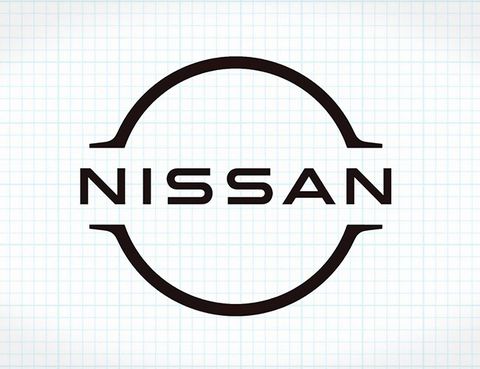
Nissan'southward current logo is a chrome bluecoat with simply "NISSAN" in a silvery rectangle centered on a silver circle. Its origins began with the Nissan's control of DAT Motors, formerly known as Datsun. The Datsun logo utilized the Datsun name in a bluish rectangle over a red circle — Japan's "Rising Dominicus" symbol, which appears on the national flag. The existing Nissan logo came about in 2001, utilizing a more modernistic estimation of the original emblem, with chrome representing sophistication, modernism, inventiveness and perfection in Nissan'southward products. Like many car logos, it recently got a modern update, beingness spiffed upwardly with a flatter look, but it's still recognizable.
Porsche
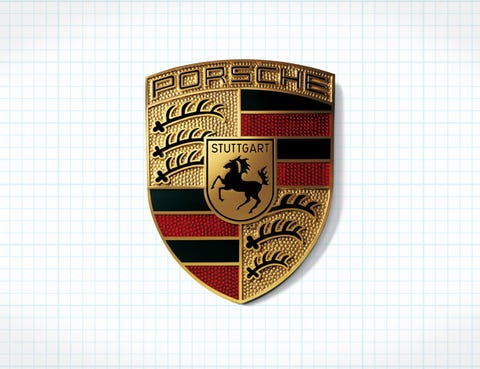
Information technology would be hard to find a more attractive emblem than the famous gilded, black and red Porsche crest. It's easily 1 of the most enduring emblems in automotive history, barely irresolute since its introduction in 1952 when Ferdinand Porsche fix out to create an iconic keepsake.
Its most obvious connection is with the urban center of Stuttgart, where Porsche is headquartered. The city originated on a stud subcontract, hence the axis of the equus caballus. The antlers and the cherry-red-and-blackness stripes in the surrounding quadrants of the shield represent the Kingdom of Württemberg, a sometime state of the Federal Republic of Germany (Stuttgart is the capital). The unchanged advent of the Porsche crest over the past several decades is consequent with the enduring legacy of its most iconic model, the 911, where the crest is displayed at the tip of its legendary flat olfactory organ.
Saab
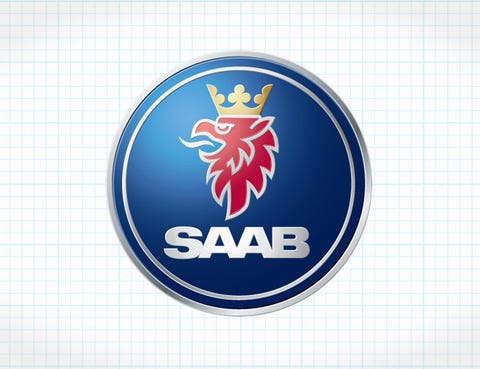
Saab's heritage dates back to airplane production in the mid 20th century. The visitor Svenska Aeroplan AB (translated "Swedish Aeroplane Limited") started producing cars in the 1950s, just the original logo symbolically bore the front of an plane propeller. Eventually, it changed to a red Griffin with a golden crown sandwiched between the Saab-Scania name. The ruby-red Griffin is inspired by a Swedish coat of arms and is besides based on the logo of Vadis-Scania's, the truck manufacturer that partnered with Saab'south parent company to class Saab-Scania. The most recent emblem, revised when GM took over in 2000, shows just the Saab name.
Subaru
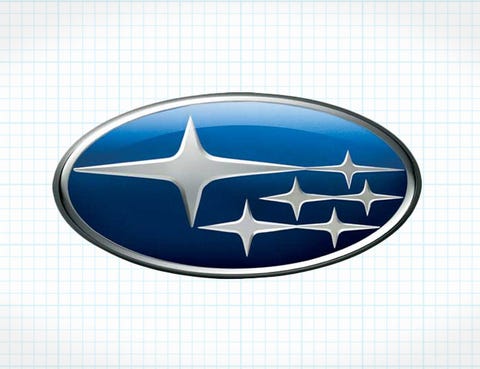
Subaru actually means "The Pleiades" in Japanese, referring to the the star cluster in the Taurus Constellation. The Subaru badge only shows six stars (Electra, Maia, Taygete, Asterope, Celaene and Alcyone) because those are the most prominently visible to the naked centre (depending on location, ambience low-cal, etc.).
In 1953, five companies merged as one: Fuji Heavy Industries Ltd. The five small stars represent the merged companies, and the larger 6th star represents the bigger firm.
Toyota
Most interpret the Toyota emblem every bit an artistic, admitting bloated interpretation of the letter of the alphabet "T". The emblem, however, actually bears meaning meaning. The ovals overlap one another, symbolizing trust between the automaker and its loyal customers. The white infinite that occupies the emblem signifies Toyota's future potential. And the three ovals together represent the collective hearts of the customer, the cars and the technological opportunities ahead.
Volkswagen
Ane of the largest automotive manufacturers in the earth, Volkswagen, happens to accept one of the simplest emblems in the business. Once again, an automaker uses an automotive emblem wrapped up in the ubiquitous circumvolve, this fourth dimension with a Five for "volks" (people, in German) and the W for "wagen" (cars), with the erstwhile stacked on the latter. The company recently gave the logo a slight refresh, but it doesn't modify the basic vibe.
Volvo
The Volvo name isn't Swedish, despite the automobile'southward origins; information technology stems from the Latin word "Volvere", for "roll." Volvo, in turn, means "I gyre" — which aptly captures the intentions of a car company.
Volvo'southward original keepsake from 1927 was a blue oval with the Volvo name centered on the logo and Gothenburg, Sweden, the manufacturer's location, on a banner beneath the name. Then, in 1930, Volvo began using its at present-famous iron alchemy/Greek male person/Mars, god of war symbol: a circumvolve with an arrow pointing up and to the right. Volvo merely recognizes the commencement association, of course. It'due south meant to symbolize strength, protection of its customers, forrard thinking and innovation. In 2014, Volvo simplified their already well-baked keepsake by moving the Volvo name completely inside the circle, as opposed to laying beyond its width.
On its cars and SUVs, Volvo's emblem is always coupled with an angled crossbar that matches the management of the arrow, providing an easily recognizable face to their lineup. The fact Volvo hasn't inverse their make image even afterward being purchased past Geely of China reassures that their priorities — safety and longevity — remain very much intact.
This content is created and maintained by a third political party, and imported onto this page to assistance users provide their email addresses. You may be able to notice more than information nearly this and similar content at piano.io
Source: https://www.gearpatrol.com/cars/a62252/car-logo-meanings/
Posted by: campbellthrecties61.blogspot.com
0 Response to "The Italian Automaker Lamborghini Uses What Animal As Its Logo?"
Post a Comment